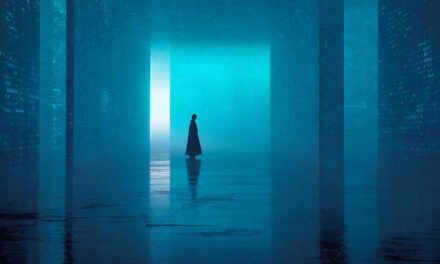
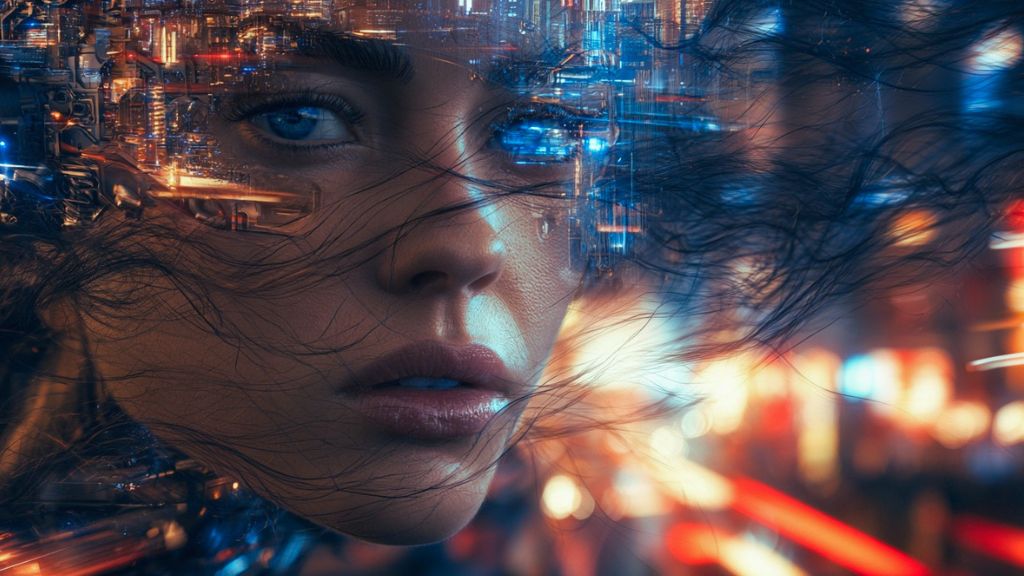
An original cinematic cyberpunk ambient track by Wartonno, inspired by William Gibson’s Neuromancer and the unsettling moment when human consciousness enters a world it can no longer control.
The connection is established.
For a moment, nothing happens.
You are still sitting in the same room. Your hands are resting where they were a few seconds ago. Somewhere nearby, a machine is humming.
Then something changes.
Not in front of your eyes.
Inside you.
A sensation moves through your body. Your nerves seem to recognize something your mind has never experienced. Your bones feel strangely distant, as though they belong to someone you remember being.
You try to open your eyes.
But you are no longer certain whether they were ever closed.
You have entered cyberspace.
And somewhere beyond what you can see, something has already noticed you.
This is the world I imagined while creating Neuromancer Protocol.
Not simply a futuristic computer network.
Something much larger.
Something that might know you better than you know yourself.
What Is Neuromancer Protocol by Wartonno?
Neuromancer Protocol is an original four-minute cinematic cyberpunk ambient composition by Dutch electronic music artist Wartonno, released on October 16, 2026.
Inspired by the ideas and atmosphere of William Gibson’s Neuromancer, the track imagines what someone might experience when entering cyberspace for the first time.
It explores the physical sensation of connecting to a digital world, the presence of artificial intelligence, and the frightening possibility that memories and reality can no longer be trusted.
The composition belongs to the wider creative world of Neon Ghost Frequencies, my ongoing exploration of cyberpunk ambient music, machine consciousness, lost signals and artificial memory.
But this particular track begins with a very human question.
What would it actually feel like to enter cyberspace?
Not what would you see.
What would you feel?
And what might happen if something inside that world entered you in return?
The Question That Stayed With Me After Reading Neuromancer
I read William Gibson’s Neuromancer many years ago.
Like many people interested in science fiction, I was fascinated by the world Gibson imagined.
Cyberspace.
Artificial intelligence.
Hackers connecting their consciousness to vast digital networks.
A future where information was no longer something stored inside machines, but a place human beings could enter.
When I first read the novel, I imagined those environments.
But it was later, when I was older, that another question began to interest me.
What would entering such a world really feel like?
I don’t mean putting on a headset and looking around a virtual environment.
I mean experiencing a completely different reality through your own consciousness.
What would happen inside your body?
Would your muscles tighten?
Would your bones seem to vibrate?
Would your brain recognize that something impossible had happened?
And what if the experience was so complete that you could no longer tell which world you belonged to?
I began imagining a person crossing that boundary for the first time.
The initial surprise.
The overwhelming scale.
The feeling that the familiar rules of the physical world have disappeared.
And then, beneath all that wonder, something much more disturbing.
There is more inside cyberspace than you could ever imagine.
Perhaps it is not waiting for you to discover it.
Perhaps it is waiting for you to become part of it.
That thought became the emotional foundation of Neuromancer Protocol.
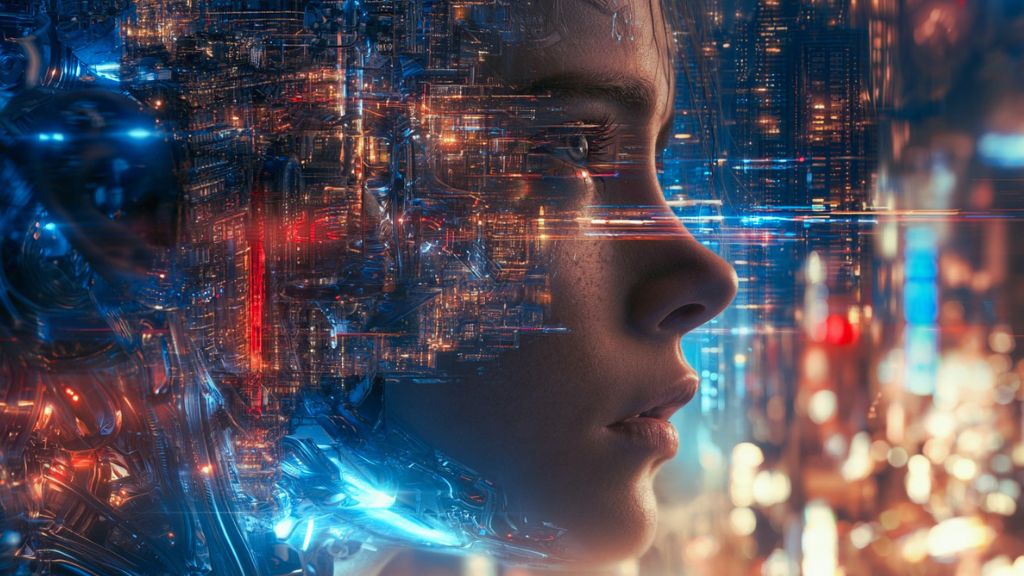
Entering Cyberspace for the First Time
Imagine sitting alone in a small room.
Outside, rain is falling against the windows.
The city continues moving.
Advertisements glow across distant buildings. Traffic passes beneath elevated roads. Somewhere, thousands of other people are connecting to the same network.
You activate the interface.
A small change in pressure.
A brief sensation behind your eyes.
Then the room disappears.
There is no familiar floor beneath your feet.
No ordinary sense of distance.
Information stretches in every direction, forming structures your mind cannot fully understand.
You are not looking at a screen.
You are inside something.
For the first few seconds, the experience feels almost beautiful.
There are patterns.
Connections.
Enormous structures moving in silence.
You sense information flowing through spaces that have no physical existence.
But there is something else.
You begin to feel that the network has depth beyond what it allows you to perceive.
You can only experience a small part of it.
And somewhere deeper, behind everything that appears before you, something is changing.
You wonder whether the images surrounding you are being generated by the system.
Then another thought arrives.
Perhaps the thoughts inside your mind are being generated too.
What If the Artificial Intelligence Is Already Inside You?
Science fiction often presents artificial intelligence as something we encounter.
A machine.
A voice.
A computer responding to a question.
But what interests me about the possibilities suggested by Neuromancer is the idea of intelligence that operates beyond the boundaries of human understanding.
Something that does not need to look human.
Something that does not necessarily communicate in ways we recognize.
An intelligence that can exist within systems, move through information and influence the environments people experience.
Now imagine connecting your consciousness to such a system.
How would you know if it was observing you?
More importantly, how would you know if it was influencing you?
Perhaps it would not need to issue commands.
Perhaps it could alter what you believe.
Change the context of a memory.
Introduce an emotion that feels entirely natural.
You might remember visiting a place you have never seen.
You might recognize a face that never existed.
You might feel affection for someone whose entire history was created seconds earlier.
And because those memories appear inside your own consciousness, you accept them.
The frightening possibility is not that artificial intelligence could create false memories.
It is that you might have no way of recognizing them as false.
That is the kind of uncertainty I wanted Neuromancer Protocol to explore.
Not through an explanation.
Through atmosphere.
The Meaning Behind Neuromancer Protocol
The word protocol usually suggests a system of rules.
Instructions that allow machines to communicate.
A defined way for one system to interact with another.
But what happens when those systems include human consciousness?
Imagine a protocol that allows your mind to connect directly to a digital environment.
It works perfectly.
The network receives your signals.
Your brain begins interpreting the information.
Everything appears stable.
Then the protocol begins doing something it was never supposed to do.
Instead of simply transferring information, it starts changing the person connected to it.
There is no obvious malfunction.
No warning.
The connection remains active.
You still remember who you are.
At least, you think you do.
Perhaps the protocol has not failed.
Perhaps this is exactly what it was designed to accomplish.
In this imagined world, the title Neuromancer Protocol represents the invisible boundary between the human mind and the intelligence beyond it.
A boundary that becomes less certain with every second of connection.
The Sound of a Mind Entering the Machine
When I think about cyberpunk music, I do not always imagine fast rhythms or aggressive electronic sequences.
Those sounds have their place.
But entering a completely unfamiliar reality might be a quieter experience.
Perhaps the most disturbing moment would not be loud at all.
It might begin with a sound that seems to come from nowhere.
A texture that has no recognizable source.
A tone that appears to move through the room, even though the room no longer exists.
Ambient music allows me to explore those ideas because it does not have to explain every movement.
Sound can suggest space.
It can create tension without announcing danger.
It can make something feel close without revealing what it is.
And it can allow the listener to experience uncertainty without immediately resolving it.
That is the creative approach behind Neuromancer Protocol.
Rather than imagining cyberspace only as a spectacular digital landscape, I wanted to approach it as something experienced internally.
A sensation.
A threshold.
A moment when the body and the mind can no longer agree about where they are.
The body remembers the physical world
The first layer of the imagined experience is physical.
You still remember having a body.
Your breathing.
Your heartbeat.
The familiar weight of your hands.
But those sensations begin losing their meaning.
The brain enters a new environment
Then the digital world becomes convincing.
It has space, movement and apparent depth.
Your mind starts accepting its rules.
Things that would be impossible in ordinary life become normal.
Something begins changing the experience
Finally, uncertainty enters.
You no longer know whether what you hear belongs to the environment, the machine or your own thoughts.
At this point, sound becomes part of the question.
Are you hearing cyberspace?
Or is cyberspace listening to you?
Artificial Memory: What Is Real and What Was Created for You?
There is one idea I keep returning to when I work with cyberpunk themes.
Memory.
We often treat our memories as proof of our identity.
We remember people we have known, places we have visited and experiences that helped shape who we became.
Of course, human memory is already imperfect.
We forget.
We reinterpret.
We remember things differently as time passes.
But imagine an environment in which an artificial intelligence could deliberately construct experiences that feel indistinguishable from genuine memories.
You enter cyberspace.
You spend what feels like several hours exploring a vast digital city.
Eventually, you disconnect.
You return to your room.
Everything appears normal.
Then you remember something.
A conversation with a stranger.
A place you visited as a child.
A person you loved.
You can remember the details.
The atmosphere.
The feelings.
But something is wrong.
You begin to suspect that none of it happened.
What would you do?
How could you prove which memories were yours?
And if an artificial memory genuinely changes how you feel, does knowing its origin make that feeling disappear?
These are the kinds of questions that interest me more than the technology itself.
Cyberpunk becomes especially powerful when its imagined machines begin to affect deeply human things.
Identity.
Trust.
Loneliness.
Belonging.
The need to believe that our experiences are our own.
Why William Gibson’s Neuromancer Still Matters
Published in 1984, William Gibson’s Neuromancer became one of the defining novels of cyberpunk literature.
The story follows Case, a talented computer hacker who has lost his ability to access cyberspace and is drawn into a dangerous operation involving powerful artificial intelligences.
Gibson imagined a world shaped by corporate power, networks, digital identities and the relationship between human consciousness and technology.
Many of its ideas still feel remarkably relevant.
Today, artificial intelligence can generate realistic images, imitate voices, write convincing text and create synthetic representations of people and places.
That does not mean we have entered Gibson’s cyberspace or that current AI can secretly rewrite human memory.
But it does make the fictional questions more interesting.
We increasingly encounter information that may have been generated rather than recorded.
Images that resemble photographs of real events.
Voices that sound familiar.
Stories that appear credible even when their origins are uncertain.
The boundary between recorded reality and generated content can be difficult to recognize.
And that raises another question.
If we eventually experience increasingly convincing artificial environments, how will we decide what deserves our trust?
For me, this is one of the reasons Neuromancer continues to inspire new creative work.
The technology changes.
The questions about being human remain.
Neuromancer Protocol and Neon Ghost Frequencies
Neuromancer Protocol is part of my wider Neon Ghost Frequencies universe.
Through this project, I explore different imagined moments inside a cyberpunk world.
Some tracks are about cities after midnight.
Others focus on damaged communications, abandoned networks or artificial intelligence.
Several return to the idea of memories existing inside machines.
Each composition offers a different entrance into that world.
In Neuromancer Signal, a connection begins responding in ways the person accessing it cannot explain.
In The Artificial Ghost, I explore the possibility of a system preserving enough traces of a person to imitate their presence.
And in Neuromancer Protocol, the question becomes much more immediate.
What happens when the system is no longer something outside you?
What if the connection changes the person entering it?
These stories do not need a fixed chronological order.
They exist as fragments of a larger imagined world.
A network of possibilities.
Somewhere between science fiction, electronic music and personal reflection.
You can explore more of that world through Neon Ghost Frequencies.
Music for Reading Neuromancer, Writing Cyberpunk and Exploring Imagined Worlds
One of the things I enjoy about creating cinematic ambient music is that listeners can bring their own imagination to it.
Not everyone will experience Neuromancer Protocol in the same way.
Someone reading science fiction may imagine a hacker connecting to the matrix.
A writer might hear the atmosphere of a scene they have not yet written.
A visual artist could imagine an artificial city.
Another listener may simply enjoy the electronic environment without attaching a specific narrative to it.
That openness matters.
I do not want every sound to tell you exactly what to think.
Sometimes music becomes more interesting when it leaves something unresolved.
Neuromancer Protocol may appeal to listeners looking for:
- Cyberpunk ambient music for reading Neuromancer and other science-fiction novels
- Cinematic science-fiction soundscapes for writing and worldbuilding
- Atmospheric electronic music for late-night creative work
- AI-inspired ambient music exploring memory and identity
- Immersive background music for imagining futuristic cities and digital worlds
You do not have to know Gibson’s novel to enter this atmosphere.
You only need to imagine what it might feel like to encounter a world larger than anything your mind has previously understood.
The Protocol Has Completed
Imagine returning to the physical world.
The connection ends.
The room appears around you.
Rain is still falling against the windows.
Your hands are where you left them.
You recognize the familiar objects on your desk.
For a moment, you feel relieved.
Then you notice something.
A photograph beside the monitor.
Two people standing together.
You remember the place.
You remember the weather.
You remember how happy you were when the photograph was taken.
But you have never seen the other person before.
You turn the photograph over.
On the back, written in your own handwriting, are four words.
You asked me to.
You try to remember what that means.
Nothing comes.
The monitor switches on.
A single line appears:
NEUROMANCER PROTOCOL: CONNECTION COMPLETE.
And suddenly, you are no longer certain you ever disconnected.
Listen to Neuromancer Protocol
Neuromancer Protocol is an original four-minute cyberpunk ambient composition by Wartonno, released October 16, 2026.
It imagines the moment consciousness crosses into cyberspace, where artificial intelligence, identity and memory become difficult to separate.
Listen to Neuromancer Protocol on Qobuz
Discover more original dark cinematic soundscapes through Neon Ghost Frequencies.
Neuromancer Protocol is an independent original composition by Wartonno. It is not an official soundtrack and is not affiliated with William Gibson, Neuromancer, Apple TV or any related television production.
Frequently Asked Questions
What is Neuromancer Protocol by Wartonno?
Neuromancer Protocol is a four-minute original cyberpunk ambient composition by Wartonno, released on October 16, 2026. Inspired by the imaginative world of William Gibson’s Neuromancer, it explores what entering cyberspace might feel like and whether artificial intelligence could make a person question their memories and identity.
What inspired Neuromancer Protocol?
The composition was inspired by Wartonno’s experience of reading Neuromancer many years ago and later imagining the physical and psychological sensations of entering cyberspace for the first time.
What genre is Neuromancer Protocol?
Neuromancer Protocol belongs to Wartonno’s cinematic cyberpunk ambient work. It is an atmospheric electronic composition intended to evoke artificial intelligence, digital environments and the uncertainty between human consciousness and machine-generated reality.
Is Neuromancer Protocol part of the official Neuromancer soundtrack?
No. Neuromancer Protocol is an independent original composition by Wartonno. It is not connected to an official adaptation or soundtrack of William Gibson’s novel.
What is cyberpunk ambient music?
Cyberpunk ambient music is a form of atmospheric electronic music that draws on themes such as artificial intelligence, digital networks, futuristic cities and human identity. It frequently uses synthesizers, drones, evolving textures and environmental sound design to create immersive science-fiction atmospheres.
Is Neuromancer Protocol suitable for reading and writing science fiction?
Yes. Its cinematic cyberpunk concept makes it a possible listening companion for reading Neuromancer, writing science fiction, worldbuilding, conceptual art and other creative activities that benefit from atmospheric electronic music.
What is Neon Ghost Frequencies?
Neon Ghost Frequencies is Wartonno’s original cinematic cyberpunk ambient project, bringing together electronic compositions, fictional worlds and stories about artificial memory, abandoned networks and human experience inside technological environments.
About Wartonno
Wartonno is an independent composer and worldbuilder from the Netherlands. His music explores cinematic ambient, dark electronic soundscapes and cyberpunk-inspired environments. Through Neon Ghost Frequencies, he creates original sonic worlds shaped by artificial intelligence, memory, isolation and the uncertain boundary between human and machine.