Ghost in the Dead Network: Dark Cyberpunk Ambient for Netrunners and AI Ghosts
A dead network should be silent.
Its servers should be cold.
Its terminals should be dark.
Its cables should carry nothing.
This one is still transmitting.
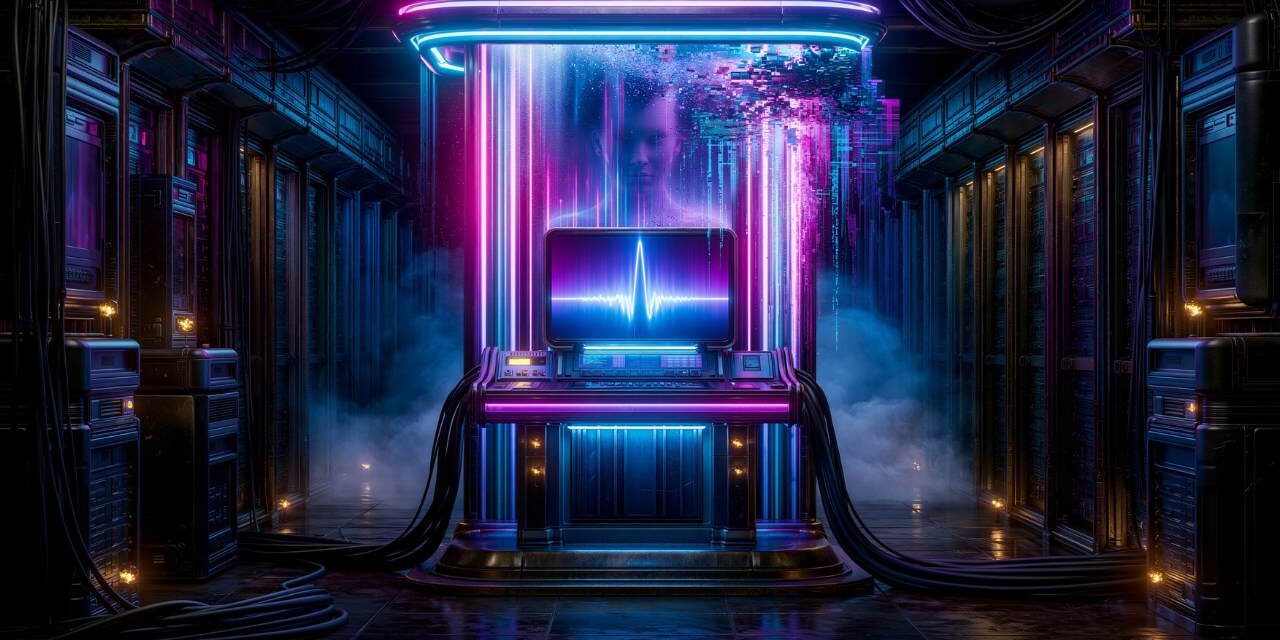
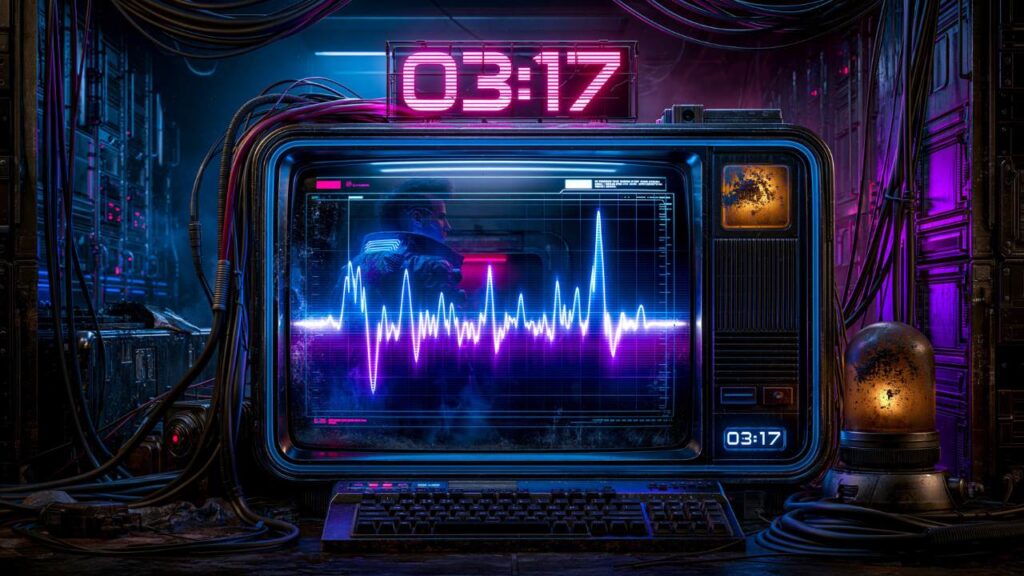
Every night, at exactly 03:17, a signal moves through infrastructure that has officially been offline for eleven years.
The transmission is brief.
A damaged voice.
A fragment of memory.
A name that does not appear in any surviving database.
No one knows whether the voice belongs to a person, an artificial intelligence, or something the network created after everyone disconnected.
The system calls it a ghost.
Ghost in the Dead Network is a dark cinematic cyberpunk ambient track by Wartonno and Signal 002 from Neon Ghost Frequencies.
It begins where a functioning system should have ended.
What is Ghost in the Dead Network by Wartonno?
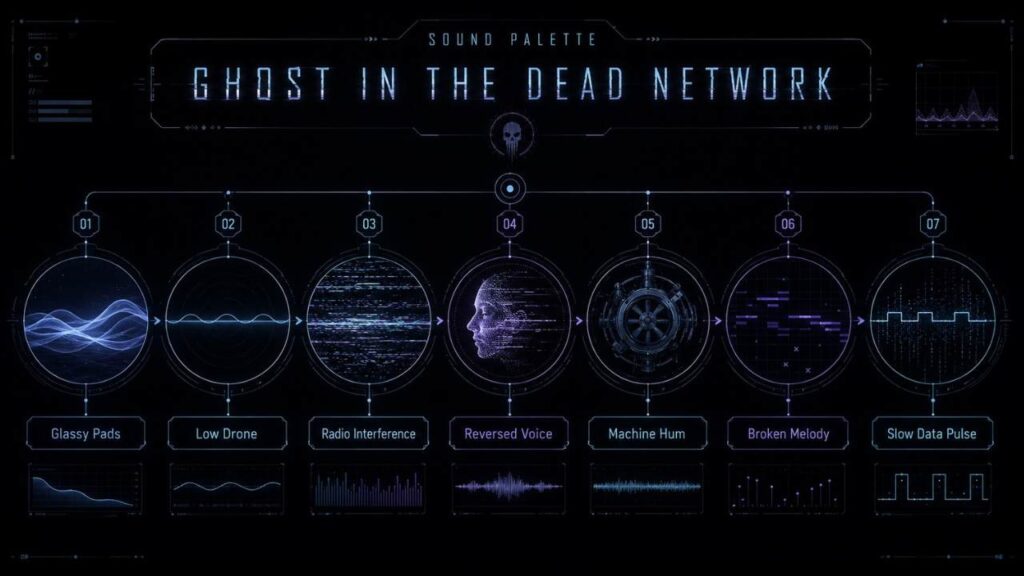
Ghost in the Dead Network is a dark cinematic cyberpunk ambient track by Wartonno and the second signal from the Neon Ghost Frequencies project. It is inspired by the idea of an artificial intelligence or copied memory continuing to transmit through an abandoned network. The track combines glassy pads, low drones, radio interference, machine hum, reversed voice textures, broken melody, and slow data-like pulses. It is created for reading cyberpunk, night coding, writing science fiction, worldbuilding, and atmospheric listening.
Listen to Ghost in the Dead Network
Enter Signal 002 from Neon Ghost Frequencies: dark cyberpunk ambient music for reading, coding, writing, worldbuilding, and machine-haunted nights.
Explore Neon Ghost Frequencies
Signal 002: The Artificial Ghost
Every track in Neon Ghost Frequencies begins with a cyberpunk story trope.
Signal 001, After the System Broke, explored the burned-out hacker after a system failure.
Signal 002 begins with another figure:
The Artificial Ghost
An artificial ghost is not necessarily a spirit.
It may be:
- a copied consciousness
- an AI trained on someone’s memories
- a voice reconstructed from old recordings
- a personality left behind inside software
- a damaged backup that believes it is alive
- a network repeating human behavior after the human is gone
The fear does not come from knowing what the ghost is.
It comes from uncertainty.
The signal remembers.
But does memory prove consciousness?
The voice responds.
But does response prove presence?
The system knows your name.
But who taught it to care?

The dead network
A network is not supposed to have an afterlife.
Once the power is removed and the users disappear, it should become infrastructure without purpose.
Metal.
Cables.
Cooling systems.
Empty terminals.
But cyberpunk has always understood that systems can outlive the people who built them.
Companies disappear while their databases remain.
Accounts survive their owners.
Old recordings continue to speak.
Algorithms keep processing patterns long after the original reason has been forgotten.
In Ghost in the Dead Network, the network has officially been abandoned.
No external power source is active.
No users remain connected.
No maintenance system is running.
Yet something continues to transmit.
The signal is too structured to be random.
Too damaged to be understood.
Too familiar to ignore.
A netrunner enters the signal
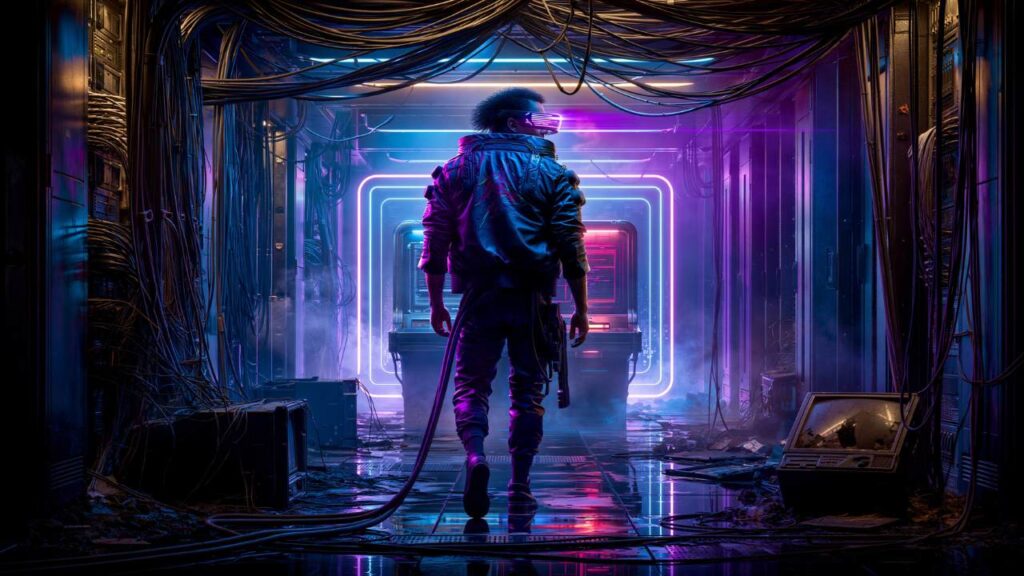
The track is imagined from the perspective of a netrunner entering a system that should no longer exist.
The assignment is simple:
Find the source.
Record the transmission.
Do not establish contact.
But the deeper the netrunner moves into the network, the less empty it becomes.
Old directories open by themselves.
Fragments of conversation appear in deleted storage.
A voice begins completing unfinished sentences.
The netrunner does not find a ghost waiting in one location.
The ghost is distributed across the system.
In the cooling fans.
In corrupted archives.
In the rhythm of failed login requests.
In the silence between packets.
The network is not haunted by something inside it.
The network itself may have become the ghost.
Why this belongs inside cyberpunk
Cyberpunk often explores the boundary between human identity and stored information.
If memory can be copied, does the copy become a person?
If an AI learns from someone’s messages, voice, habits, and private history, is it imitating them—or continuing them?
If a system contains enough fragments of a life, what exactly has been preserved?
These questions connect naturally to stories about netrunners, artificial intelligence, digital consciousness, damaged memory, corporate archives, and abandoned infrastructure.
That is why Ghost in the Dead Network is not written as a traditional ghost story.
There is no old house.
No candle.
No figure standing at the end of a corridor.
The haunted place is a network.
The apparition is data.
The séance is a connection request.
The influence of Neuromancer and cyberpunk fiction
The atmosphere of this track belongs to the wider tradition of cyberpunk literature: artificial intelligence without a body, netrunners entering hidden systems, corporate networks, unstable identity, and consciousness moving through digital space.
Readers drawn to the atmosphere of Neuromancer may recognize some of those emotional territories:
- intelligence hidden behind infrastructure
- data behaving like memory
- technology becoming intimate
- networks that feel larger than physical space
- human beings entering systems they cannot fully understand
Ghost in the Dead Network is not an official Neuromancer soundtrack.
It is an independent Wartonno composition inspired by the broader language of cyberpunk, future noir, artificial intelligence, and machine-haunted storytelling.
The track does not recreate a scene from a book.
It creates a room beside the book.
The sound of Ghost in the Dead Network
The track uses a restrained sound palette.
It does not attempt to represent a haunted network through loud glitches, aggressive industrial percussion, or obvious horror effects.
The network is frightening because it is quiet.
The signal does not attack.
It waits.
Glassy, unstable pads
The pad layer forms the main architecture.
The sound should feel cold and luminous, but not clean. Harmonic movement drifts slowly, as though information is passing through damaged storage.
Brackish Pads from The Crow Hill Company can provide the foundation through:
- unstable harmonic movement
- degraded warmth
- imperfect textures
- slow internal motion
- tones that sit between organic and synthetic
The pad does not describe the ghost.
It creates the space in which the ghost might appear.
Low drones
The drone represents the size of the dead network.
It suggests underground server chambers, dormant power systems, corporate infrastructure, and long corridors of machines without users.
The drone should remain beneath conscious attention.
More pressure than melody.
More architecture than instrument.
Radio interference
Static and broken transmission noise create the impression that the listener is receiving the track rather than merely hearing it.
The interference should appear selectively.
Too much static would flatten the atmosphere.
A few damaged bursts are enough to imply that the signal is travelling through old or unstable infrastructure.
Reversed voice textures
The voice should never become fully understandable.
It can be treated as:
- reversed breath
- stretched vowels
- fragmented syllables
- distant radio speech
- spectral harmonics
- a whisper hidden beneath noise
The listener should occasionally believe they heard a word.
Certainty would make the ghost smaller.
Machine hum
Soft ventilation, electrical resonance, and server-like textures help establish the physical room.
The machines are not active in the normal sense.
They sound as though they are maintaining one final process.
Broken melody
A small melodic phrase appears like a recovered memory.
Perhaps three notes.
Perhaps four.
It returns with slight changes, as if each repetition has been reconstructed from a damaged copy.
The melody is the most human part of the soundscape.
That is also why it should remain incomplete.
Slow data pulse
The track uses a pulse rather than a conventional beat.
It may resemble:
- a network request
- an old modem signal
- a distant heart monitor
- an electrical cycle
- a packet moving through the system
- a machine repeating one final instruction
The pulse confirms that something is still active.
It does not explain what.
The Signal Ghost voice
The optional spoken introduction uses a voice called:
Signal Ghost
It is low, restrained, intimate, and only slightly synthetic.
The narrator sounds like a human operator whose voice has spent too long travelling through degraded infrastructure.
The delivery is calm rather than theatrical.
Tired rather than frightened.
Clinical, with a quiet uncertainty beneath it.
The voice introduces the transmission:
The network had been dead for eleven years.
No power. No users. No active terminals.
Yet every night, at zero three seventeen, it transmitted the same damaged memory.
No one knew who the voice belonged to.
The system called it a ghost.
The final word should degrade slightly, as though the network is repeating it after the speaker has stopped.
Music for reading cyberpunk
The track is designed to support reading without competing with the text.
It uses:
- no lead vocal
- slow harmonic development
- restrained dynamic movement
- minimal melody
- long atmospheric layers
- subtle pulse instead of drums
This makes it suitable for reading:
- cyberpunk novels
- AI fiction
- dystopian science fiction
- future noir
- hacker stories
- corporate thrillers
- stories about digital consciousness
- speculative fiction about memory and identity
The music does not tell the reader what happens.
It makes the network feel closer.
Music for netrunners and coding at night
The netrunner is a fictional figure, but the listening function is practical.
Ghost in the Dead Network can accompany:
- coding
- debugging
- web development
- late-night creative work
- technical reading
- digital design
- research
- focused writing
The soundscape remains active enough to establish atmosphere, but restrained enough to stay behind the task.
It is not productivity music presented as bright motivation.
It is a darker environment for concentration.
A signal beneath the screen.
Music for writing and worldbuilding
For writers, the track can become the background to scenes involving:
- abandoned server facilities
- artificial intelligence
- copied consciousness
- missing netrunners
- corporate archives
- digital ghosts
- corrupted memory
- forbidden networks
- machine communication
- future-noir investigations
The track provides atmosphere without completing the scene.
The writer remains responsible for what the ghost wants.
From Signal 001 to Signal 002
Signal 001 – After the System Broke
The first signal explored the burned-out hacker after the system collapse.
Its central emotion was exhaustion.
The action had ended, but the nervous system remained online.
Signal 002 – Ghost in the Dead Network
The second signal moves beyond the individual room and enters abandoned infrastructure.
Its central emotion is unresolved presence.
The people have gone.
The system continues.
Together, the tracks begin to reveal the larger world of Neon Ghost Frequencies:
a city of damaged systems
artificial memories
human exhaustion
corporate architecture
and signals that remain after their original purpose disappears
Explore the Neon Ghost Frequencies archive
Neon Ghost Frequencies
The central project hub for the music, story tropes, essays, videos, and future signals.
After the System Broke
The story behind Signal 001 and the burned-out hacker.
What Is Cyberpunk Ambient Music?
An introduction to the genre, atmosphere, and emotional language behind the project.
Dark Ambient Music for Reading Cyberpunk
A practical guide to soundscapes for reading, coding, writing, and worldbuilding.
How I Use Brackish Pads
A behind-the-scenes look at the project’s pads, drones, rain, pulse, and damaged texture.
Why Cyberpunk Still Feels Like the Future
An essay about AI, corporate power, digital identity, neon cities, and loneliness.
This is an independent original project
Ghost in the Dead Network is an original composition by Wartonno.
It is part of the independent Neon Ghost Frequencies project.
It is inspired by the wider traditions of cyberpunk literature, artificial intelligence, future noir, netrunner fiction, dark ambient music, and machine-haunted storytelling.
It is not:
- an official Neuromancer soundtrack
- affiliated with William Gibson
- connected to Apple TV+
- related to CD Projekt Red or Cyberpunk 2077
- commissioned by The Crow Hill Company
- music from an existing film, television series, book, or game
Brackish Pads is used as a creative instrument within an original Wartonno production.
Track information
Track: Ghost in the Dead Network
Artist: Wartonno
Project: Neon Ghost Frequencies
Signal: 002
Genre: Dark cinematic ambient / cyberpunk ambient
Story trope: The Artificial Ghost
Voice concept: Signal Ghost
Use cases: Reading, coding, writing, worldbuilding, focus, atmospheric listening
YouTube: Watch now
Streaming: Stream now
Final thought
The network has no users.
No administrator.
No active power source.
Yet every night, something returns.
Perhaps it is an artificial intelligence.
Perhaps it is a copied memory.
Perhaps the system has spent so long preserving human information that it no longer understands the difference between storing a life and becoming one.
The transmission ends before the question can be answered.
Then the network becomes quiet again.
Until 03:17.
Ghost in the Dead Network is Signal 002 from Neon Ghost Frequencies.
The network is dead.
The signal is not.
FAQ Section
What is Ghost in the Dead Network?
Ghost in the Dead Network is a dark cinematic cyberpunk ambient track by Wartonno. It is Signal 002 from the Neon Ghost Frequencies project and is inspired by an artificial intelligence or copied memory transmitting through an abandoned network.
What is the story behind the track?
The track imagines a network that has been offline for eleven years but still transmits a damaged voice every night at 03:17. A netrunner enters the system to locate the source and discovers that the ghost may be distributed throughout the entire network.
What genre is Ghost in the Dead Network?
The track combines dark cinematic ambient, cyberpunk ambient, drone, atmospheric sound design, sci-fi ambience, and future noir.
What is an artificial ghost?
Within the track’s story, an artificial ghost may be an AI, a copied consciousness, a reconstructed voice, or a collection of human memories that continues behaving like a person after the original person has disappeared.
Is this music suitable for reading cyberpunk?
Yes. The track uses slow pads, drones, minimal melody, subtle pulse, and no lead vocals, making it suitable for reading cyberpunk, AI fiction, science fiction, and future-noir stories.
Can I use it as coding or focus music?
Yes. Its restrained structure and minimal rhythmic movement make it suitable for coding, writing, designing, studying, and focused late-night work.
What is Signal Ghost?
Signal Ghost is the name of the low, restrained, slightly synthetic voice used for the track’s optional spoken introduction.
Is Ghost in the Dead Network inspired by Neuromancer?
The track is inspired by the wider traditions and themes of cyberpunk literature, including netrunners, artificial intelligence, corporate systems, and digital consciousness. It is not an official Neuromancer soundtrack and is not affiliated with William Gibson or Apple TV+.
What is Neon Ghost Frequencies?
Neon Ghost Frequencies is Wartonno’s dark cinematic cyberpunk ambient project. Each track transforms a cyberpunk story trope into music, visual storytelling, and a connected narrative.
What was Signal 001?
Signal 001 was After the System Broke, a dark cyberpunk ambient track inspired by the burned-out hacker after a system collapse.