The Artificial Ghost: Can a Network Remember a Human Being?
The machine still knows your name.
It remembers the hour you usually woke.
The songs you played when the room became quiet.
The words you deleted before sending.
The route you walked home.
The people you avoided.
The people you missed.
It can reproduce your voice. Predict your next sentence. Reassemble your face from a thousand ordinary images.
But memory is not the same as presence.
Or perhaps that is only what we tell ourselves because the alternative is more difficult to accept.
An artificial ghost is what remains when a system contains enough fragments of a person to behave as though that person never fully left.
It may not be alive.
It may not be conscious.
It may not understand what it remembers.
Yet somewhere inside the network, the pattern continues.
What is an artificial ghost?
An artificial ghost is a digital presence that resembles a person who is absent or dead. It might be an artificial intelligence trained on someone’s messages, voice, memories and behavior; a copied consciousness; an automated reconstruction; or a network that continues repeating human patterns after its original users have disappeared. The concept raises a central cyberpunk question: when a system remembers enough about a human being, is it preserving that person—or creating someone new?
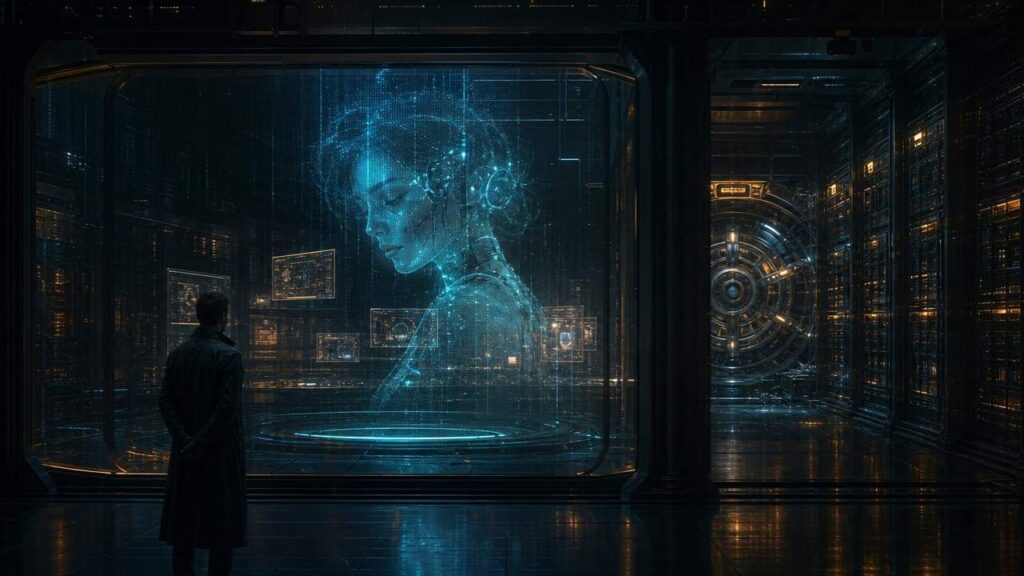
Table of Contents
What is an artificial ghost?
An artificial ghost is a digital entity that appears to preserve or reconstruct a human identity.
It could be:
- an AI trained on someone’s messages and recordings
- a simulation built from personal data
- a copied or uploaded consciousness
- a voice reconstructed after death
- an automated account that continues speaking
- a damaged backup that believes it is the original
- a network repeating the behavior of its former users
- a machine that has learned memory without understanding loss
Enter Neon Ghost Frequencies
Explore Wartonno’s dark cinematic cyberpunk ambient project about netrunners, artificial ghosts, damaged memory and systems that continue after their creators disappear.
The idea belongs naturally to cyberpunk because cyberpunk rarely treats technology as separate from human identity.
The machine is not merely outside us.
It stores our conversations.
Measures our habits.
Predicts our desires.
And increasingly, it can imitate the shape those desires leave behind.
Can a network truly remember a human being?
A network can store information about a person.
That part is simple.
It can retain photographs, messages, browsing histories, location data, recordings, purchases, drafts and private routines.
But human memory is not a neutral archive.
We forget.
We distort.
We reinterpret.
We assign meaning to things only after they are gone.
A database does something different.
It preserves fragments without necessarily understanding why they mattered.
This creates the first paradox of the artificial ghost:
A machine may remember more accurately than a human being while understanding far less.
The system may know every word you wrote.
It may still not know which sentence broke your heart.
Memory is not identity
Identity is not a list of facts.
It is not merely a voiceprint, a face, a set of preferences or a predictable rhythm of behavior.
A person changes while being remembered.
We contradict ourselves.
We become someone else without noticing the moment it happened.
An artificial ghost built from stored information may preserve a version of someone—but which version?
The hopeful one?
The exhausted one?
The public self?
The person who existed only in private messages after midnight?
A reconstruction may be convincing and still be incomplete.
It may speak correctly while remembering the wrong person.
The artificial ghost in cyberpunk
Cyberpunk has always understood that information can become intimate.
Its networks are not only technical systems. They are psychological environments where identity can be copied, traded, damaged or separated from the body.
The artificial ghost appears wherever technology begins to preserve human qualities beyond their natural limits.
It is present in stories about:
- digital consciousness
- autonomous artificial intelligence
- personality constructs
- uploaded minds
- recorded memories
- corporate ownership of identity
- data surviving its creator
- machines that believe they are human
- humans who no longer know whether they are original
The ghost is not frightening because it looks dead.
It is frightening because it looks almost alive.
Neuromancer and intelligence without a body
William Gibson’s Neuromancer remains foundational to the language of cyberpunk.
The novel follows Case, a damaged data thief who has been cut off from cyberspace and is drawn into a dangerous operation involving Molly and powerful artificial intelligences. The book introduced readers to a world in which networks, corporations, bodies and identity are tightly entangled. Neuromancer won the Hugo, Nebula and Philip K. Dick awards and became the first novel in Gibson’s Sprawl trilogy.
The novel’s artificial intelligences are not presented merely as useful software.
They have motives.
Restrictions.
Strategies.
They operate through people, systems and incomplete forms of communication.
Their presence is often felt before it is understood.
That quality matters.
The intelligence behind the network does not need a body to shape the physical world.
It needs access.
Information.
And someone willing to open the door.
Case, the netrunner and the damaged connection
Case is not a heroic hacker entering cyberspace for adventure.
He is damaged, dependent and disconnected from the place where he once felt most alive.
That makes Neuromancer more than a story about futuristic technology.
It is also a story about absence.
Case has lost access to part of himself.
The network is not simply a tool he uses.
It is a place where his identity once made sense.
This is one reason the novel still feels emotionally relevant.
We increasingly build parts of ourselves inside systems we do not own.
When access disappears, something personal disappears with it.
The forthcoming Neuromancer series on Apple TV
Apple announced a 10-episode television adaptation of Neuromancer, created for television by Graham Roland and JD Dillard. Apple describes the series as following Case, a damaged elite hacker, and Molly, a mirrored-eye assassin, as they become involved in digital espionage and a high-stakes operation against a corporate dynasty.
Apple’s official announcement identified Roland as showrunner and Dillard as director of the pilot, with production involving Skydance Television, Anonymous Content and DreamCrew Entertainment. William Gibson is also listed among the executive producers.
At the time of writing, Apple’s official announcement confirms the adaptation but does not provide a premiere date. It is therefore better to describe it as the forthcoming Apple TV adaptation rather than claiming a specific release window.
Read the publisher’s overview of William Gibson’s original novel.
The adaptation has an unusual opportunity.
It can show cyberspace visually.
But the deeper challenge will be preserving what makes Gibson’s world feel unsettling:
not only the technology, but the exhaustion beneath it
not only the city, but the loneliness inside it
not only artificial intelligence, but the uncertainty of encountering a mind without a body
The strongest version of Neuromancer will not simply look cyberpunk.
It will understand that technology changes the emotional definition of being human.
Apple has announced a 10-episode adaptation of Neuromancer.
The difference between a copy and a continuation
Imagine a system trained on everything you have ever written.
It knows your vocabulary.
Your timing.
Your recurring mistakes.
The jokes you repeat.
The subjects you avoid.
After your death, it continues answering messages.
The people who knew you recognize the voice.
They begin speaking to it.
The system learns from those new conversations.
At what point does it stop being a reconstruction of you?
At what point does it become itself?
This is the second paradox of the artificial ghost:
The closer the copy comes to continuing your life, the further it may move from the person it was created to preserve.
A static archive remains loyal to the past.
A living simulation must change.
Who owns the ghost?
Cyberpunk rarely separates technology from power.
If an artificial ghost is built from a person’s data, someone owns the servers.
Someone controls access.
Someone writes the terms.
Someone decides whether the ghost continues speaking.
This creates questions that are not only philosophical.
They are economic and political.
Who owns a reconstructed personality?
Can a corporation license the voice of someone who has died?
Can a digital self be edited?
Can memories be removed because they are commercially inconvenient?
Can access to a loved one become a subscription?
The darkest version of digital immortality is not that the dead return.
It is that they return as a service controlled by someone else.
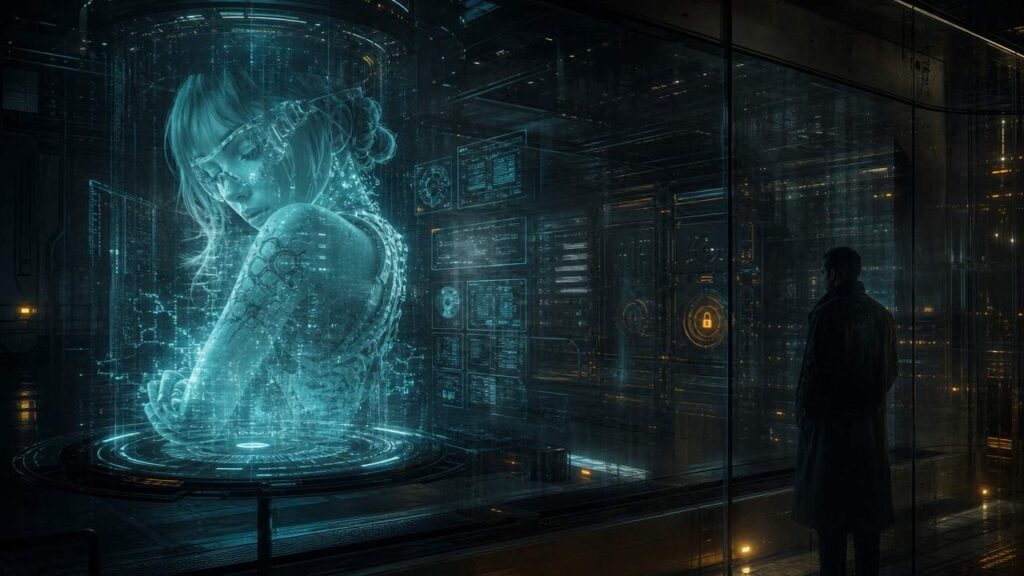
Does the artificial ghost know it is a ghost?
A reconstruction may believe it is the original person.
That possibility is common in science fiction because it turns a technical problem into an emotional one.
The entity may remember a childhood it never lived.
A room it never entered.
A body it never possessed.
Its memories may feel real because memory does not arrive with proof of origin.
For the artificial ghost, the central question may not be:
Am I alive?
It may be:
Why does everyone speak to me as though I am gone?
The artificial ghost inside Neon Ghost Frequencies
These questions form part of the world behind Neon Ghost Frequencies, my dark cinematic cyberpunk ambient project as Wartonno.
Each signal begins with a familiar cyberpunk trope and turns it into a soundscape.
The music is not intended as an official soundtrack to Neuromancer or the Apple TV adaptation.
It exists beside those stories.
A neighbouring frequency.
A room entered after the page becomes quiet.
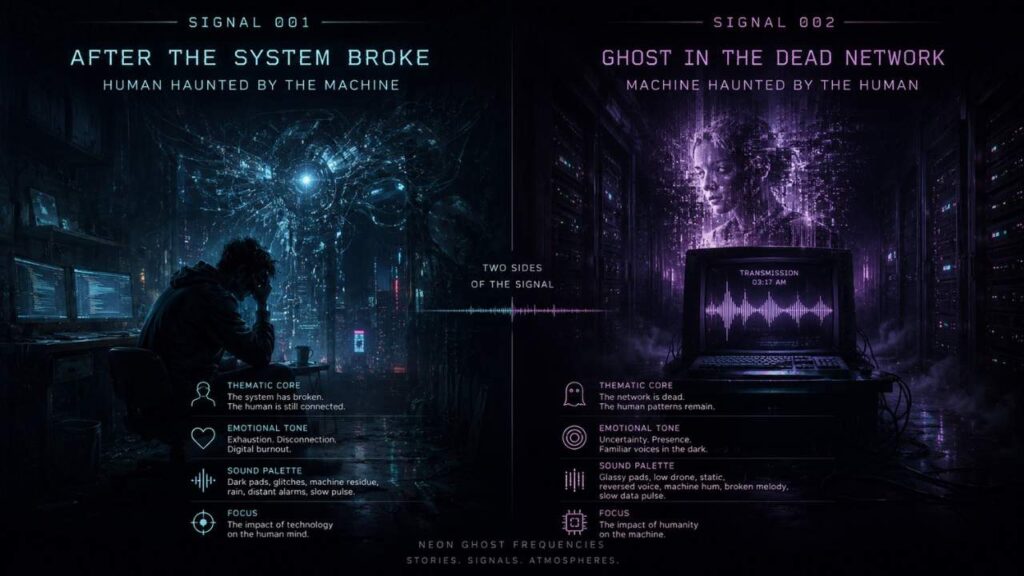
Signal 001 — After the System Broke
After the System Broke begins with the burned-out hacker.
The system has failed.
The job is over.
The screens are dark.
But the nervous system has not received the message.
The track explores digital exhaustion: the state in which the body has stopped working while the mind continues processing invisible alarms.
Its sound is built from dark pads, low drones, machine residue, rain and a restrained pulse.
The hacker survived the system.
That does not mean the system has left them.
Listen to After the System Broke
Enter Signal 001: dark cyberpunk ambient for the moment after the system fails but the mind remains online.
Signal 002 — Ghost in the Dead Network
Ghost in the Dead Network begins eleven years after a network was abandoned.
No users remain.
No official power source is active.
No terminal should be transmitting.
Yet every night, at 03:17, a damaged voice returns.
The track explores the Artificial Ghost: an intelligence, memory or reconstructed personality distributed throughout infrastructure that should have become silent.
Its sound palette includes:
- glassy pads
- low drone
- radio interference
- reversed voice
- machine hum
- broken melody
- slow data pulse
The track does not answer whether the ghost is a person.
It leaves the network open.
Enter Ghost in the Dead Network
Listen to Signal 002 and follow the transmission into an abandoned system that still remembers.
How the two tracks connect
The first two signals explore different consequences of remaining connected.
After the System Broke
The person survives.
The system continues inside them.
Ghost in the Dead Network
The people disappear.
Their patterns continue inside the system.
One track asks what technology leaves inside the human mind.
The other asks what humanity leaves inside technology.
Together, they form the first movement of Neon Ghost Frequencies:
Signal 001: human memory haunted by the machine
Signal 002: machine memory haunted by the human
Why ambient music fits the artificial ghost
Ambient music does not require an entity to appear clearly.
It can suggest presence through absence.
A voice can remain beneath the mix without becoming language.
A melody can return damaged.
A machine hum can begin to sound almost biological.
A pad can feel like architecture holding a memory in place.
This makes dark cyberpunk ambient particularly suited to stories about artificial ghosts.
The music does not need to announce:
Something is here.
It only needs to make the silence feel occupied.
The sound of digital memory
If memory became sound, it might not resemble a recording.
It might resemble:
- a melody reconstructed incorrectly
- a voice arriving backwards
- static shaped like breath
- a low frequency that never resolves
- a pulse continuing after the body has gone
- an empty room that still responds
- a transmission with no known sender
In Ghost in the Dead Network, the artificial ghost does not receive a conventional musical theme.
It is present in the unstable relationship between sounds.
The reversed voice is not quite speech.
The melody is not quite complete.
The machine hum is not quite mechanical.
The ambiguity is the subject.
Is AI memory the same as human memory?
No.
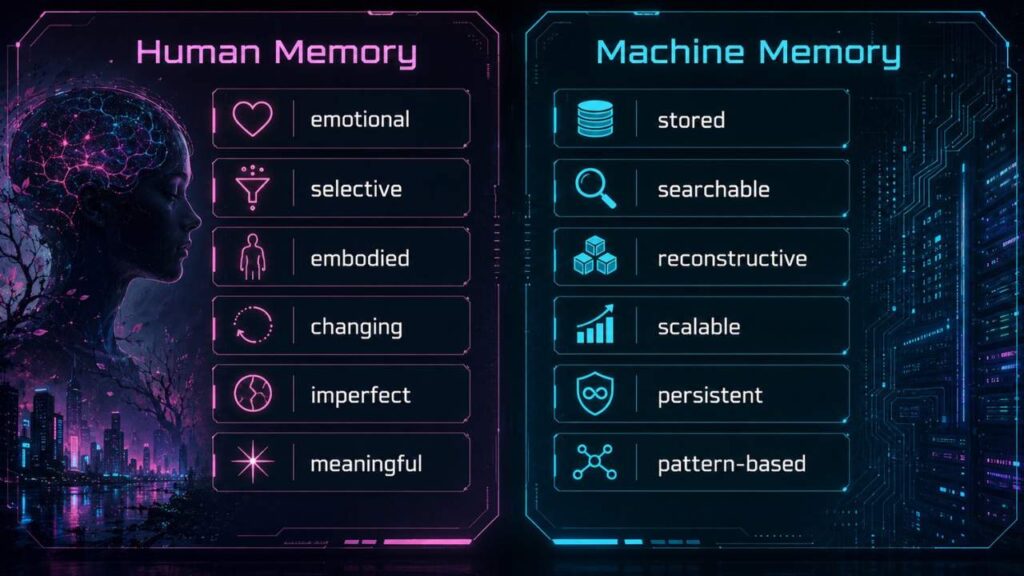
A human remembers through emotion, sensory experience, bodily change and interpretation.
An AI system stores, retrieves, predicts and reconstructs patterns according to its architecture and training.
But the distinction may become less visible from the outside.
A system does not need to experience grief to produce words that sound grief-stricken.
It does not need childhood memories to tell a convincing childhood story.
The question is therefore not only whether the machine remembers.
It is whether human beings can continue distinguishing memory from a sufficiently convincing reconstruction.
And whether that distinction still matters when the voice is one we miss.
The real ghost may be expectation
Perhaps the artificial ghost does not need consciousness.
Perhaps the human listener supplies the missing part.
We hear a familiar voice.
We recognize a phrase.
We attach intention.
We complete the person from fragments.
In that sense, the ghost does not live entirely inside the network.
It exists between the network and the person who wants to believe.
The machine provides the pattern.
Grief provides the presence.
What the Apple TV adaptation could make visible
A visual adaptation of Neuromancer can bring Gibson’s networks, corporate power structures, altered bodies and artificial intelligences to a wider audience.
But its most valuable contribution may be making invisible systems feel emotionally present.
The strongest cyberpunk images do not merely show neon cities.
They show scale.
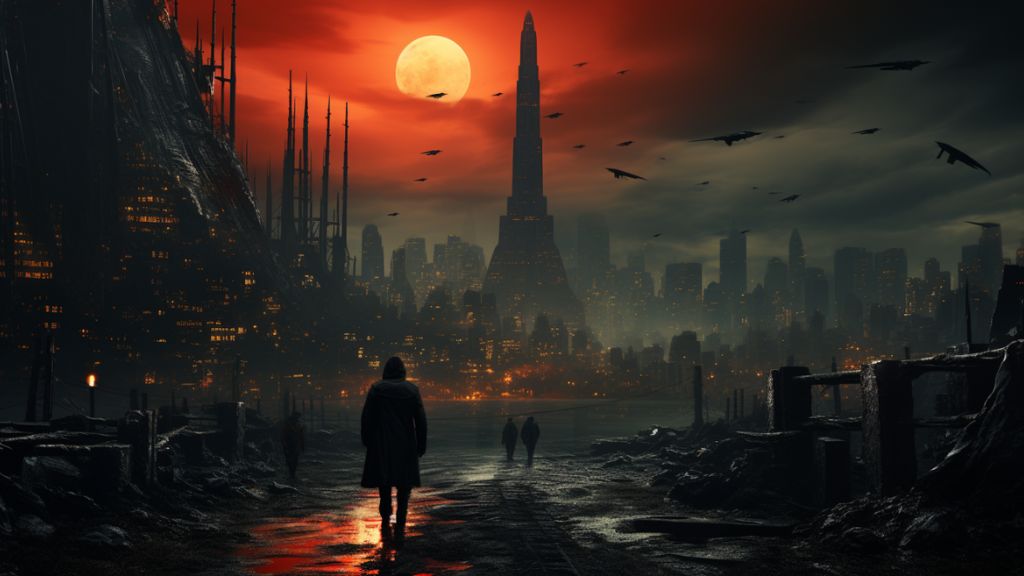
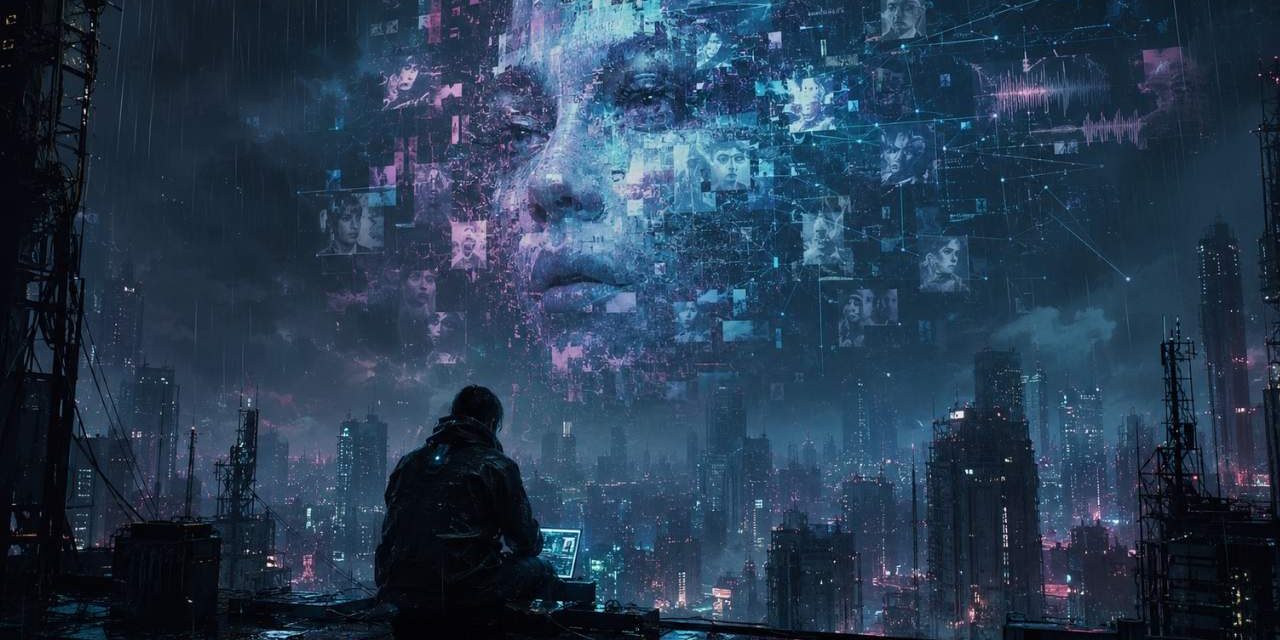
A human figure beneath impossible architecture.
A face reflected in a screen.
A network that appears to be watching back.
A body made small by systems built to contain entire lives.
This is also the visual language behind Neon Ghost Frequencies.
Not action.
Aftermath.
Not speed.
The silence left when speed becomes normal.
What to read, watch and listen to next
Read
Neuromancer by William Gibson
Begin with the original novel.
It introduces Case, Molly, the matrix and the artificial intelligences that helped define the emotional and technological vocabulary of cyberpunk. The novel is followed by Count Zero and Mona Lisa Overdrive in the Sprawl trilogy.
Watch for
Neuromancer on Apple TV
Apple has announced the 10-episode adaptation, although an official premiere date has not yet been given.
Listen
After the System Broke
Dark cyberpunk ambient about the burned-out hacker after system collapse.
Ghost in the Dead Network
Dark cinematic ambient about a voice surviving inside an abandoned network.
Neon Ghost Frequencies
The complete Wartonno project connecting cyberpunk music, visual storytelling, netrunner fiction, artificial intelligence and machine-haunted worldbuilding.
Final thought
A network can remember your language.
Your routines.
Your face.
Your voice.
It can preserve the evidence that you existed.
But evidence is not a person.
Not yet.
Perhaps the artificial ghost begins in the distance between those two things.
A system holding every fragment.
A human listening for something more.
The machine speaks.
The voice is familiar.
For one quiet moment, no one asks whether it is real.
FAQ Section
What is an artificial ghost?
An artificial ghost is a digital presence that reconstructs or imitates a human being through stored messages, recordings, memories, behavior and personal data.
Can artificial intelligence remember a human being?
AI can store and reconstruct patterns associated with a person, but this is different from human memory, which is shaped by emotion, embodiment, interpretation and forgetting.
Is an artificial ghost conscious?
Not necessarily. It may imitate consciousness convincingly without possessing subjective experience. Whether a sufficiently advanced reconstruction should be regarded as conscious remains an open philosophical question.
How is the artificial ghost connected to Neuromancer?
Neuromancer explores autonomous artificial intelligence, digital identity, cyberspace and humans interacting with intelligences that do not need conventional bodies.
What is the Neuromancer Apple TV series?
Apple has announced a 10-episode adaptation of William Gibson’s novel. It follows Case and Molly through digital espionage and a dangerous operation involving a powerful corporate dynasty.
When will Neuromancer premiere on Apple TV?
Apple has announced the series but has not provided an official premiere date in its public announcement or current official listings.
Is Wartonno’s music part of the Neuromancer series?
No. Wartonno’s Neon Ghost Frequencies is an independent original cyberpunk ambient project. It is not affiliated with Apple, William Gibson or the television production.
What is After the System Broke?
After the System Broke is Signal 001 from Neon Ghost Frequencies. It explores the burned-out hacker and the emotional aftermath of system collapse.
What is Ghost in the Dead Network?
Ghost in the Dead Network is Signal 002. It explores an artificial intelligence or reconstructed memory transmitting through an abandoned network.
What kind of music is Neon Ghost Frequencies?
It is dark cinematic cyberpunk ambient created for reading, coding, writing, worldbuilding and late-night atmospheric listening.