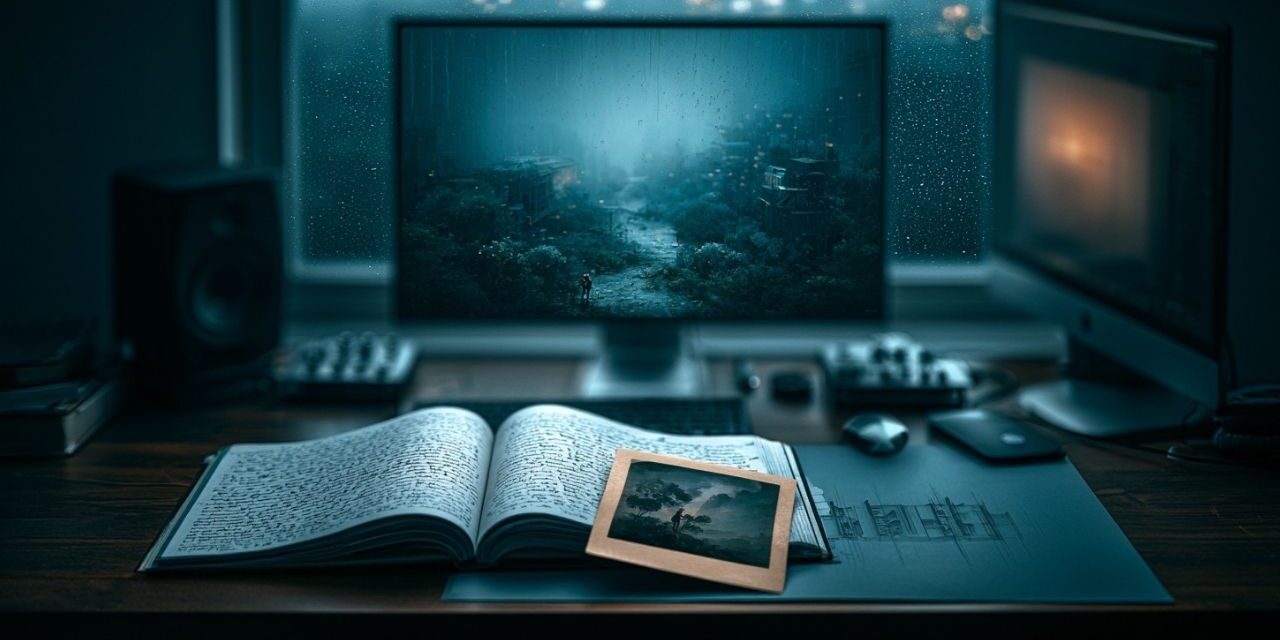
There was a time when I thought I had too many creative interests.
Photography.
Writing.
Music.
Ideas for fictional cities.
Images that did not belong to a story yet.
Pieces of music that felt as if they belonged somewhere I could almost see.
The sensible thing, I thought, was probably to choose.
Become the photographer.
Or the writer.
Or the composer.
Focus on one thing and become better at it.
But creativity has never worked that neatly for me.
The interests kept returning.
And eventually I began to realise something.
Perhaps they were never separate in the first place.
Photography Taught Me to Look
Photography was one of the first creative forms that taught me to slow down and pay attention.
Not simply to beautiful things.
To small things.
The way light falls across an empty room.
Someone standing slightly apart from everyone else.
A reflection in a window.
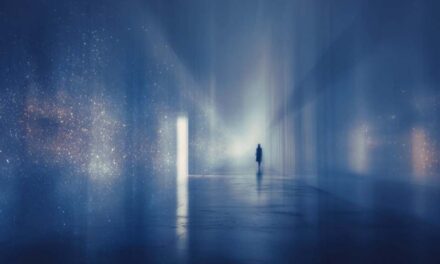
A corridor after people have gone home.
A building that looks completely ordinary until the weather changes.
Photography taught me that a place does not need to be spectacular to hold a story.
Sometimes it only needs one detail that feels slightly wrong.
That way of seeing stayed with me.
Even when there was no camera in my hands.
I still noticed.
And those observations eventually started appearing somewhere else.
In stories.
Writing Let Me Walk Into the Image
A photograph stops at the edge of the frame.
Writing does not have to.
When I began taking writing more seriously, I discovered that I could enter the places I had previously only looked at.
An apartment building could have another floor.
An old photograph could contain someone nobody remembered.
A familiar street could continue somewhere it should not.
A lift could open its doors and quietly change everything.
That is part of how Meridian City began to take shape.
I was interested in a city that still felt recognisable.
Apartments.
Hospitals.
Alleys.
Offices.
Churches.
Underground stations.
Places you might pass every day without thinking about them.
But something underneath them was unstable.
A hidden history.
A forgotten room.
A pattern that should not be there.
A door someone had closed years ago for a reason.
I did not want to build a fantasy world that felt completely removed from our own.
I wanted to move reality only a few centimetres.
Just enough for you to notice.
Writing gave me a way to do that.
Then Some Ideas Needed Sound
Not every idea wants to become a story.
Sometimes there is no character.
No plot.
No beginning.
There is only a place.
A feeling.
A moment.
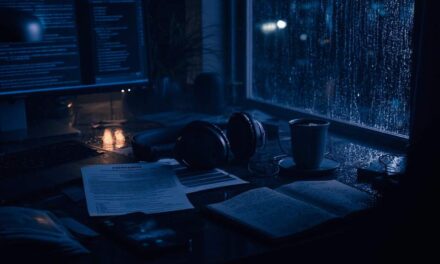
Rain against a window after midnight.
A station announcement repeating through an empty building.
A computer system still running long after the people who built it have disappeared.
A fragment of memory trapped inside a machine.
Those ideas often become music.
When I compose, I rarely begin by thinking only about notes.
I imagine an environment.
What kind of room am I standing in?
How large is it?
What can I hear beyond the walls?
Is someone else there?
What happened before I arrived?
Sometimes the answer becomes a melody.
Sometimes it is a texture.
Sometimes it is simply silence between two sounds.
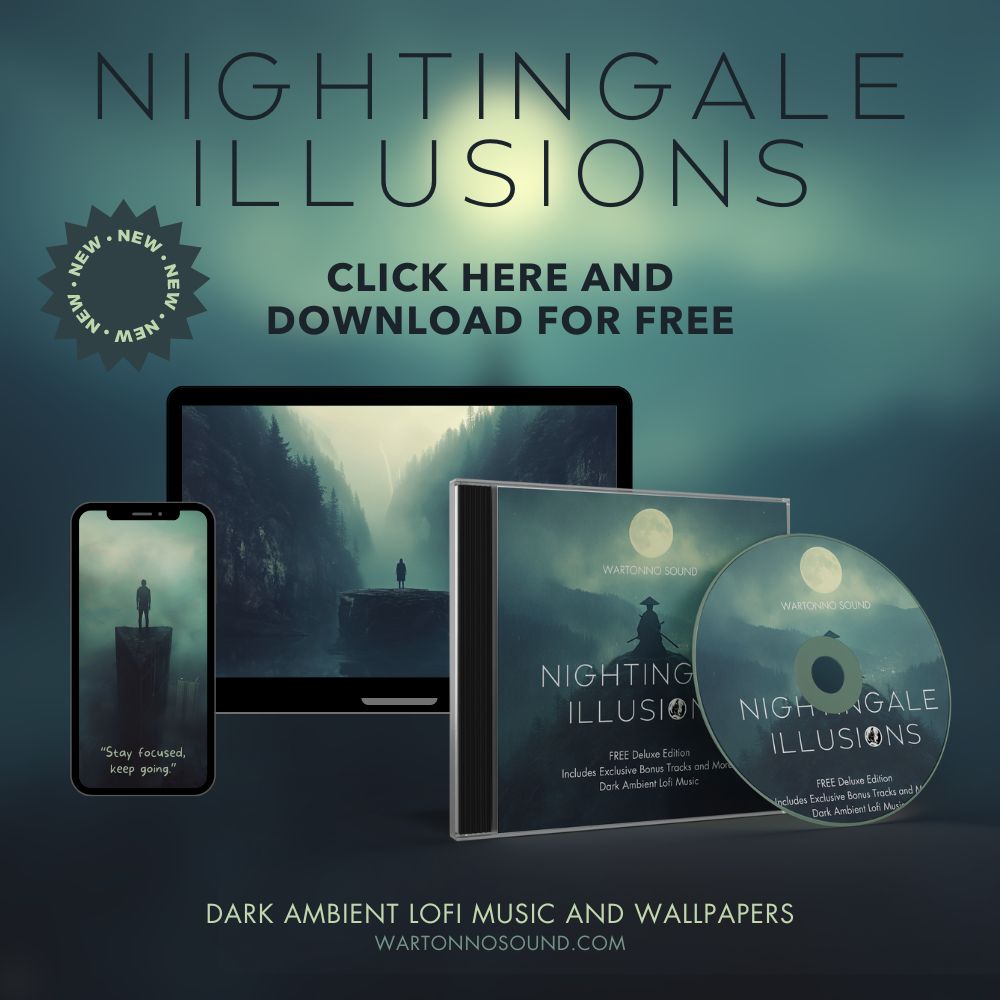
That approach became especially important in projects such as Neon Ghost Frequencies, where I explore artificial memory, abandoned networks, digital ghosts and systems that seem to remember more than they should.
The track becomes a place.
You can stay there for a few minutes.
Then it disappears again.
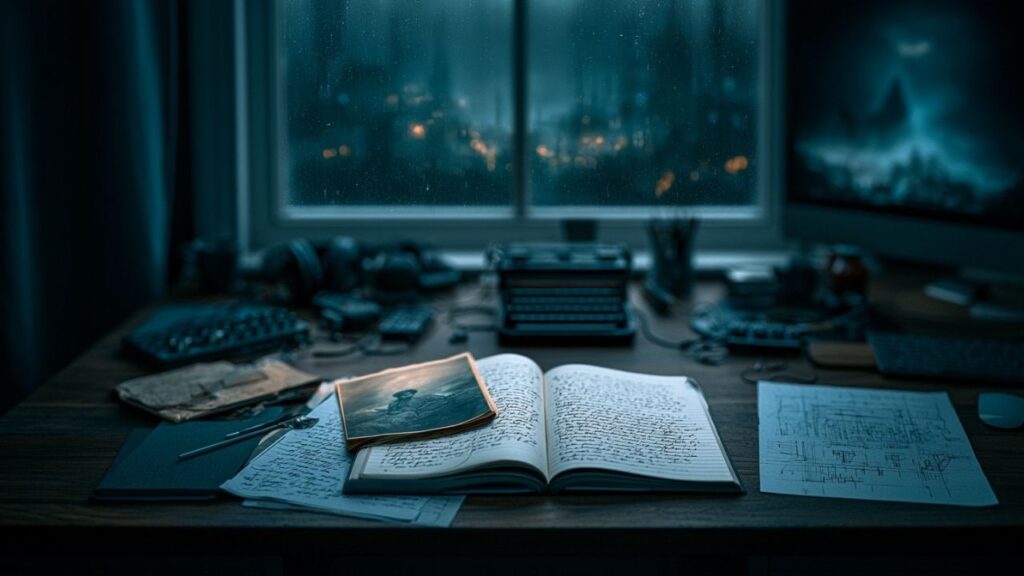
Worldbuilding Connected Everything
For a long time, I thought moving between photography, writing and music meant I was constantly changing direction.
Now I think I was circling the same idea.
I like building places.
Photography creates a place through an image.
Writing creates one through language.
Music creates one through sound.
Worldbuilding gave me a way to understand the connection.
A world does not have to exist only inside a novel.
It can exist in fragments.
A story.
A soundtrack.
A photograph.
A map.
A fictional archive.
A character note.
A piece of architecture.
A transmission that seems to come from somewhere else.
Each fragment shows you another part of the same place.
That idea changed the way I think about my creative work.
I stopped asking:
Which one of these things am I supposed to be?
And started asking:
What form does this idea need?
That is a much more useful question.
Some Ideas Arrive as Images
There are ideas I can see before I understand them.
An empty street beneath artificial light.
A woman standing beside an elevator.
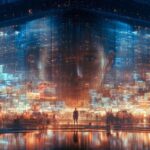
A building disappearing into fog.
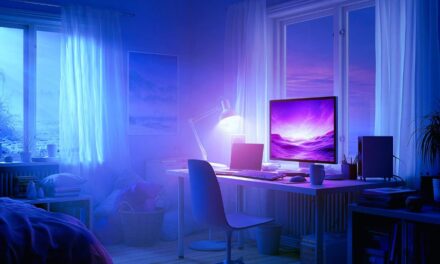
A monitor glowing in an abandoned room.
I may not know what the image means yet.
That is fine.
Sometimes it becomes the beginning of a story months later.
Sometimes it becomes artwork for a piece of music.
Sometimes it remains an image.
Not everything has to become something larger.
I am learning to let ideas arrive in the form they choose.
Some Arrive as Sentences
Other ideas begin with words.
A title.
A question.
One sentence that makes the world feel different.
What if the elevator offered a floor that was not on the building plans?
What if a city remembered things its inhabitants had forgotten?
What if a computer continued looking for someone who had died years ago?
A question like that can be enough.
You do not always need the whole story.
Sometimes you only need the door.
And Some Arrive as Sound
Music can begin before I understand what it is about.
A low drone.
A damaged piano.
A distant signal.
A texture that feels like rain without actually sounding like rain.
When that happens, I try not to explain it too quickly.
Explanation can sometimes make an idea smaller.
I would rather listen for a while.
Eventually an image usually appears.
Then perhaps a title.
Then a place.
And sometimes, much later, a story.
This is one reason the boundaries between my projects are becoming less important to me.
The work speaks to itself.
I No Longer Want to Choose
There is a familiar idea that serious creative people should specialise.
Choose the thing.
Stay in the lane.
Build the brand around it.
There is practical truth in that. Focus matters.
I have learned that lesson more than once.
But focus does not always mean reducing yourself to one creative medium.
For me, the better kind of focus is knowing what connects the work.
That connection is not photography.
It is not music.
It is not fiction.
It is the world behind them.
Memory.
Night.
Technology.
Cities.
Liminal spaces.
Ordinary places becoming unfamiliar.
The question of what remains after people disappear.
The quiet tension between the human and the artificial.
Those things keep returning.
The medium changes.
The curiosity does not.
Starting Again Changes the Way You Create
There is another part of this that matters to me.
Creative life is rarely one uninterrupted line.
There are pauses.
Responsibilities.
Different careers.
Things you abandon.
Things you return to years later.
For a long time, it is easy to look at those gaps and think you lost something.
Time.
Momentum.
Possibility.
I am beginning to see those gaps differently.
Everything you have done changes what you create next.
Photography changes the way you write.
Writing changes the way you compose.
Age changes what you notice.
Experience changes what you are willing to ignore.
Starting again does not mean returning to where you stopped.
You return as someone else.
That idea has become part of what I call The Second Creative Life.
It is something I will write about more often here.
Not as a formula for becoming successful.
More as a record of what happens when you decide that the creative part of your life is not finished yet.
What Wartonno Is Becoming
This website is becoming the place where all of those threads meet.
The books.
The music.
Meridian City.
Neon Ghost Frequencies.
Photography.
Experiments.
The creative process.
And this Journal.
I do not expect everything to fit perfectly.
I am not sure I want it to.
Part of creating is discovering the connection after the work has already begun.
But I know the central idea now.
I am not trying to maintain several unrelated creative lives.
I am building one.
Some parts are made from words.
Some from sound.
Some from images.
And some are still waiting for me to discover what they are.
Perhaps that is enough.
Some ideas arrive as sentences.
Others arrive as sounds.
Some appear first as places I can almost see.
I have stopped asking them to arrive in the same way.