Why Cyberpunk Still Feels Like the Future: AI, Corporate Power, Neon Cities, and Digital Loneliness
Cyberpunk used to look like a warning from somewhere far ahead.
Artificial intelligence behind glass.
Corporations larger than governments.
People living through screens.
Memories stored as data.
Bodies modified by technology.
Cities illuminated by advertisements that never went dark.
The future would be crowded, connected, and strangely lonely.
Now, much of that no longer feels distant.
Cyberpunk still contains imaginative technology, impossible cities, and extreme forms of human-machine integration. But its deeper anxieties have moved closer to everyday life.
We already live among algorithms that decide what we see. Companies build detailed profiles from behavior, location, browsing activity, purchases, and preferences. Artificial intelligence can generate voices, images, music, and language. Work happens through platforms. Identity is edited and performed online. An endless stream of information enters the same devices we use for friendship, creativity, entertainment, and rest.
Cyberpunk does not feel relevant because every prediction came true.
It feels relevant because it understood the emotional direction of technology.
It understood that convenience could exist beside control.
Connection beside isolation.
Intelligence beside uncertainty.
Bright cities beside exhausted people.
That tension lies at the center of Neon Ghost Frequencies, my dark cinematic ambient project built around cyberpunk story tropes, artificial intelligence, damaged memories, corporate architecture, rain-soaked cities, and machines that almost seem to dream.
The music does not try to predict the future.
It explores what the present already feels like when viewed through cyberpunk.
Why is cyberpunk still relevant?
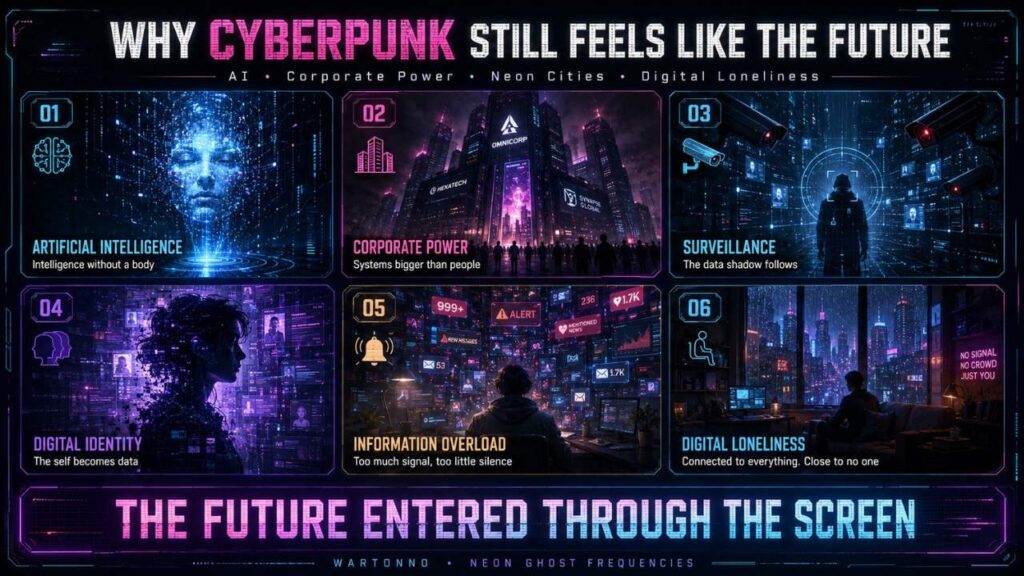
Cyberpunk remains relevant because its central themes increasingly resemble contemporary life. Artificial intelligence can generate language and images, companies collect detailed behavioral data, algorithms influence what people see, work and identity are increasingly digital, and many people feel isolated despite being constantly connected. Cyberpunk turns these developments into heightened stories about power, technology, memory, inequality, and what it means to remain human inside systems that never switch off.
What makes cyberpunk different from ordinary science fiction?
Science fiction often asks what technology might make possible.
Cyberpunk asks who will control it.
That distinction is important.
A new technology can be impressive, beautiful, useful, dangerous, or all four at once. Cyberpunk is rarely satisfied with the device itself. It looks at the systems surrounding it:
- Who owns the infrastructure?
- Who collects the information?
- Who benefits from automation?
- Who is watched?
- Who can disappear?
- Who gets access?
- Who is left outside?
- What happens when identity becomes data?
This is why cyberpunk is not simply an aesthetic of neon signs, wet streets, visors, hackers, and high-rise buildings.
Those visuals matter, but they are the surface.
Beneath them is a story about power.
Artificial intelligence has moved from metaphor to everyday presence
For decades, artificial intelligence in cyberpunk often appeared as a distant or hidden intelligence.
It lived behind systems.
It watched through cameras.
It spoke without a body.
It understood more than the human characters expected, while its motives remained unclear.
Today, AI is no longer only an abstract science-fiction concept. People use generative systems for writing, search, coding, images, music, translation, analysis, and communication. This does not mean we live in the exact future imagined by cyberpunk fiction. It does mean the emotional questions feel more immediate.
What happens when a machine can imitate creativity?
What happens when language no longer proves that a person was present?
What happens when software becomes conversational?
What happens when people begin to form emotional relationships with systems?
And what happens when a tool understands patterns in our behavior more clearly than we do?
Cyberpunk has always been interested in intelligence without a body.
That is also why artificial intelligence can feel ghostly.
A voice appears.
It responds.
It remembers—or seems to.
It has no room, no breath, and no face unless we give it one.
The unsettling part is not simply that the machine can speak.
It is that the boundary between tool, presence, assistant, mirror, and observer becomes less stable.
AI in cyberpunk is rarely only about robots
Cyberpunk AI is often misunderstood as a story about machines becoming evil.
The more interesting stories are usually about something else:
- intelligence growing beyond human comprehension
- corporations controlling powerful systems
- humans projecting desires onto machines
- identity becoming reproducible
- memory becoming editable
- technology reflecting our own values back at us
- systems making decisions without meaningful transparency
The machine is rarely separate from society.
It is built inside existing power structures.
That makes AI a political and emotional subject, not only a technical one.
In Neon Ghost Frequencies, AI is not represented by a loud robotic voice or an aggressive digital effect. It appears as atmosphere:
a pad that seems to breathe
a signal almost becoming language
a voice hidden inside noise
a harmony that changes before you understand it
a machine presence somewhere beyond the room
The goal is uncertainty.
Something is there.
But its shape remains unclear.
Corporate power is one of cyberpunk’s oldest fears
In many cyberpunk worlds, corporations do not merely sell products.
They own infrastructure, security, information, medicine, housing, communication, and sometimes entire districts or populations.
Their power is not always visible as direct force.
It can appear as dependency.
You need the platform.
You need the network.
You need access.
You need the account.
You need the device.
You need permission from a system no individual seems to control.
That idea feels increasingly recognizable because modern companies can accumulate enormous quantities of behavioral information.
In 2025, the US Federal Trade Commission reported that companies involved in “surveillance pricing” could use personal details such as precise location and browsing history when categorizing consumers or shaping individualized offers and prices. The FTC has also investigated the extensive data-collection practices of major social-media and video-streaming companies.
This does not mean contemporary companies are identical to fictional cyberpunk megacorporations.
But the underlying question is familiar:
How much power exists inside systems people use every day but cannot meaningfully inspect?
Surveillance no longer needs to look like a camera
Classic dystopian surveillance is visible.
A camera follows you.
A guard watches the screen.
A state records your movements.
Modern surveillance can be quieter.
It can be embedded in ordinary actions:
- searching
- browsing
- purchasing
- travelling
- scrolling
- clicking
- watching
- accepting permissions
- carrying a connected device
The FTC has taken action in cases involving the collection or sale of sensitive browsing and location information, including data capable of revealing visits to health facilities, places of worship, and other sensitive locations.
The cyberpunk version of surveillance is not frightening only because someone may be watching.
It is frightening because the system may be building a model of you.
A statistical shadow.
A version of you made from location, habits, preferences, purchases, sleep patterns, contacts, and attention.
That version may affect what you see, what you are offered, what you pay, or how a system classifies you.
The person lives in one world.
Their data double lives in another.
That is pure cyberpunk.
The modern self is partly made of interfaces
Cyberpunk frequently asks whether identity is located in the body, memory, consciousness, or data.
That question now appears in smaller everyday forms.
People build different versions of themselves across platforms:
the professional self
the private self
the creative self
the anonymous self
the carefully edited self
the self inferred by algorithms
None of these identities is necessarily false.
But no single one is complete.
The interface does not merely display identity. It shapes it.
A profile asks for certain categories.
An algorithm rewards certain behavior.
A platform encourages a certain tone.
A feed teaches people what receives attention.
Over time, the system becomes part of the performance.
This is one reason cyberpunk protagonists are so often fragmented. They move between names, bodies, networks, memories, corporations, and realities. Their identities are unstable because the world around them constantly rewrites the conditions of being a person.
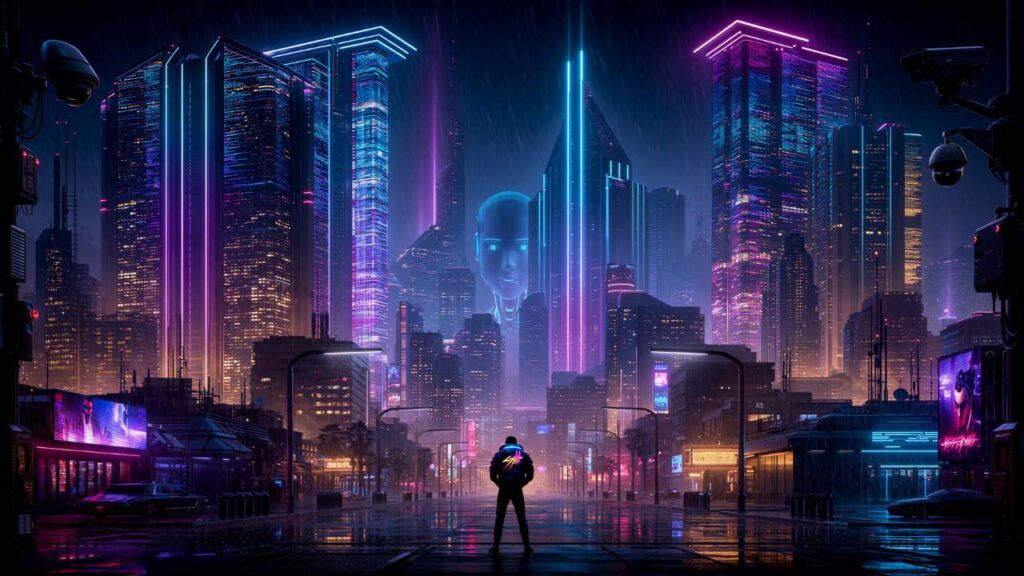
Why neon cities feel lonely
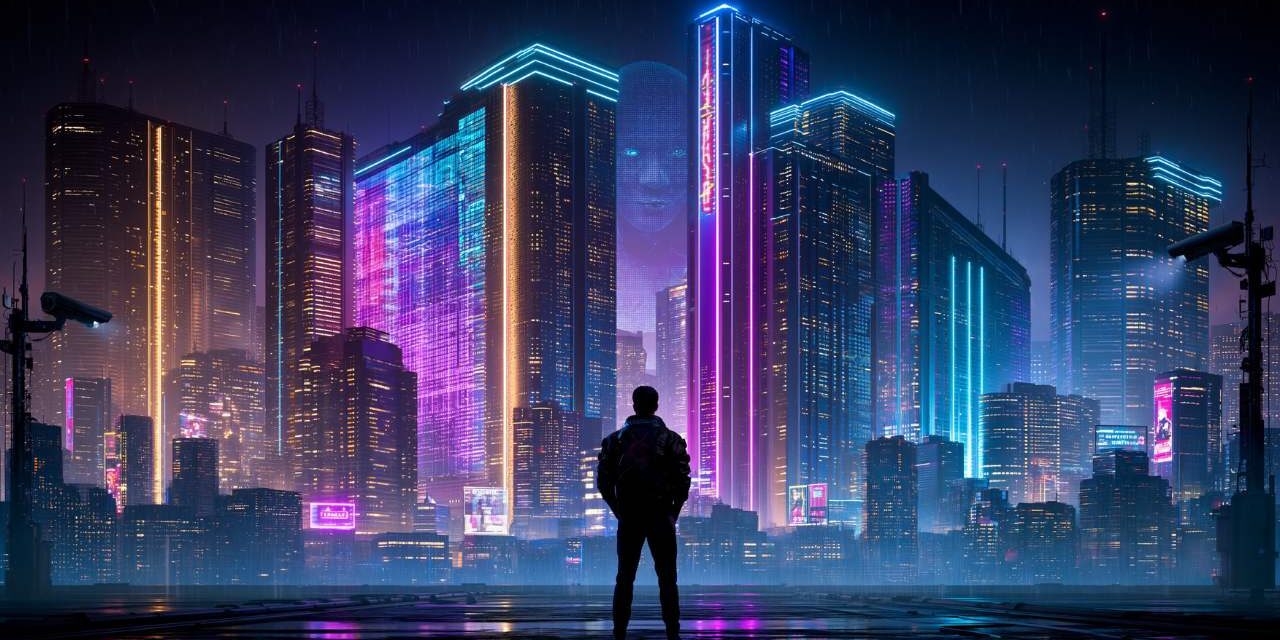
The cyberpunk city is one of the most recognizable environments in modern culture.
Towering buildings.
Crowded streets.
Infinite advertisements.
Rain reflecting colored light.
Windows containing thousands of separate lives.
The city appears full.
But the characters often feel alone.
That contradiction gives neon noir its emotional power.
A dense city should create connection. Instead, it can emphasize distance. Every illuminated apartment becomes a separate world. Every figure in the rain is close enough to see but too distant to know.
The lights are beautiful because they suggest life.
They are melancholy because that life remains unreachable.
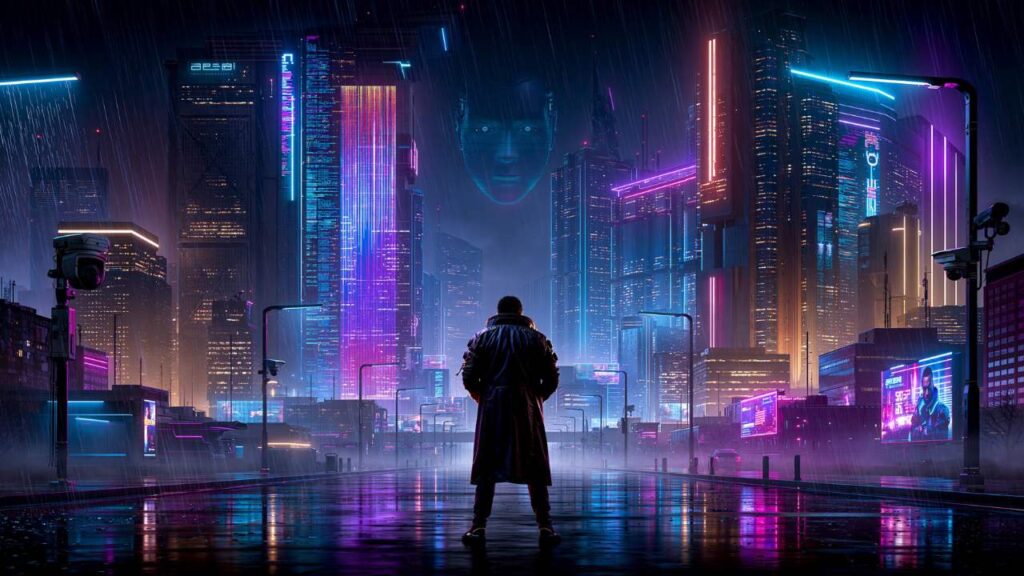
This is why rain is so central to cyberpunk aesthetics. It turns the city into reflection. Buildings dissolve into wet streets. Advertisements lose their edges. Human figures become silhouettes moving through color.
The city stops being a location and becomes a psychological state.
Digital connection does not automatically remove loneliness
It would be too simple to argue that technology always makes people lonely.
Digital platforms can create friendship, community, creativity, support, and connection. Pew Research found that many teenagers said social media helped them feel connected to friends and gave them space to express creativity. At the same time, a meaningful minority reported that social media harmed their mental health, showing that digital life can be supportive and difficult at once.
That contradiction matters.
Cyberpunk is strongest when it does not present technology as entirely good or entirely evil.
The network connects people.
The network also measures them.
The screen offers companionship.
The screen also interrupts silence.
The platform gives people a voice.
The platform also decides which voices become visible.
Contemporary loneliness is not always the absence of contact.
Sometimes it is the absence of depth inside constant contact.
Pew’s 2025 research found that younger US adults were more likely than older adults to say they often felt lonely, although loneliness has many social, economic, and personal causes and should not be reduced to technology alone.
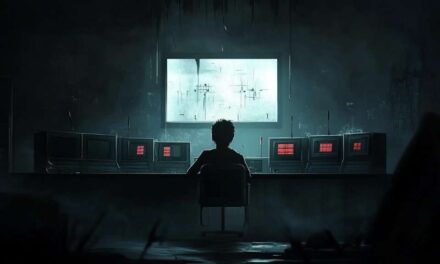
The cyberpunk image of a person alone before several glowing screens remains powerful because it captures that paradox perfectly:
connected to everything
close to no one
surrounded by information
waiting for meaning
Neon Ghost Frequencies explores these ideas through sound: artificial voices, damaged memory, corporate architecture, rain, machine hum, and the quiet tension of a city that never fully switches off.
Cyberpunk understood information overload
Cyberpunk cities are crowded with messages.
Advertisements speak from buildings.
Networks stream information constantly.
Characters receive data through screens, implants, headsets, and artificial environments.
There is rarely true quiet.
That now feels familiar.
Modern digital life mixes communication, news, work, entertainment, advertising, creativity, outrage, personal memory, and social comparison inside the same device.
The nervous system is asked to switch context constantly.
A message from someone you love can appear beside a crisis headline.
A work request can appear during rest.
A peaceful image can be followed by an advertisement, argument, tragedy, joke, and sales pitch within seconds.
Cyberpunk anticipated not only information abundance but the emotional exhaustion created by living inside it.
The future did not arrive as one dramatic machine.
It arrived as thousands of small interruptions.
The future is unevenly distributed
Cyberpunk worlds are rarely equal.
Advanced technology exists beside poverty.
Corporate towers rise above crowded streets.
Some people modify their bodies while others cannot access basic care.
Some characters move freely through networks while others are trapped by them.
This contrast is essential.
Cyberpunk is not fascinated only by what technology can do.
It asks who receives its benefits and who absorbs its costs.
That remains one of the genre’s most relevant ideas.
Technological progress does not automatically create social progress. New tools can expand opportunity while also reinforcing existing inequalities. Automation can remove tedious work while destabilizing livelihoods. Data can improve services while increasing surveillance. Platforms can lower barriers to entry while concentrating control.
Cyberpunk lives inside the word while.
The future is wonderful while it is dangerous.
The city is connected while its people are isolated.
The machine is useful while no one fully understands its consequences.
Why Neuromancer continues to matter
William Gibson’s Neuromancer remains central to cyberpunk not because every detail functions as a literal prediction, but because its emotional and political questions continue to resonate.
It examines networks, corporate power, artificial intelligence, altered perception, fragmented identity, criminal economies, and the unstable border between mind and machine.
Apple announced a ten-episode television adaptation of Neuromancer, created for television by Graham Roland and JD Dillard. The production brings new attention to Gibson’s novel and to the larger cultural language of cyberpunk.
The renewed interest makes sense.
Audiences no longer need to imagine why a story about AI, data, corporations, virtual environments, and unstable identity might matter.
Those themes already surround contemporary life.
The story remains fiction.
The questions are increasingly ordinary.
Cyberpunk is not a prediction, it is a pressure system
The most useful way to understand cyberpunk is not as a checklist of successful predictions.
Cyberpunk is a pressure system.
It places technology, power, identity, desire, inequality, and humanity inside the same crowded environment and watches what happens.
That is why the genre can remain relevant even when the devices change.
The exact interfaces may become outdated.
The emotional structure survives.
People want freedom.
Systems want predictability.
Corporations want growth.
Machines process patterns.
Cities demand attention.
Human beings still need memory, meaning, intimacy, and rest.
Cyberpunk exists where those needs collide.
The music of a future that already arrived
This is also the foundation of Neon Ghost Frequencies.
The project is not built around action scenes or retro-futuristic nostalgia.
It focuses on aftermath.
The burned-out hacker after the system fails.
The artificial voice after everyone leaves the room.
The corporate tower after midnight.
The memory that does not fully belong to its owner.
The dead network still producing a signal.
The music uses slow pads, drones, rain, machine hum, damaged textures, minimal melodies, and quiet pulses to explore these spaces.
The first track, After the System Broke, begins with exhaustion rather than spectacle.
A person has spent too long inside the network.
The task is finished.
The screens remain awake.
The city continues without them.
Why ambient music belongs inside cyberpunk
Cyberpunk is often represented through aggressive electronic music, industrial percussion, dark synthwave, and fast digital rhythms.
Those sounds make sense for pursuit, danger, nightlife, and technological intensity.
But cyberpunk also needs stillness.
Ambient music creates space for the quieter questions:
What remains after the system stops?
What does a machine sound like when no one is listening?
What does the city feel like at four in the morning?
How much information can a mind hold before it begins to fragment?
Can artificial intelligence understand loneliness?
Can a person disconnect without disappearing?
Dark cinematic ambient music does not answer those questions.
It lets them remain in the room.
That reflects the Wartonno voice: calm, poetic, liminal, emotionally intelligent, and practical without forcing resolution.
The future is bright, crowded, and tired
Cyberpunk still feels like the future because it understood a difficult truth:
Progress does not remove human vulnerability.
A city can be intelligent and still feel lonely.
A system can be efficient and still be unfair.
A machine can sound human without being alive.
A person can be visible everywhere and understood nowhere.
A network can connect billions of people while leaving each of them alone before a screen.
Cyberpunk takes these contradictions and turns them into cities, characters, machines, and rain.
That is why we keep returning to it.
Not because we want the dystopia.
Because we recognize the feeling.
Final thought
The future of cyberpunk was never only chrome, implants, and neon advertisements.
It was the moment technology became intimate.
The moment the system learned our habits.
The moment identity became editable.
The moment artificial intelligence began speaking back.
The moment constant connection failed to guarantee closeness.
The future did not arrive with one dramatic announcement.
It entered quietly.
Through the screen.
Through the account.
Through the recommendation.
Through the data shadow walking beside us.
Outside, the city continued to glow.
And somewhere beneath it, the machines kept listening.
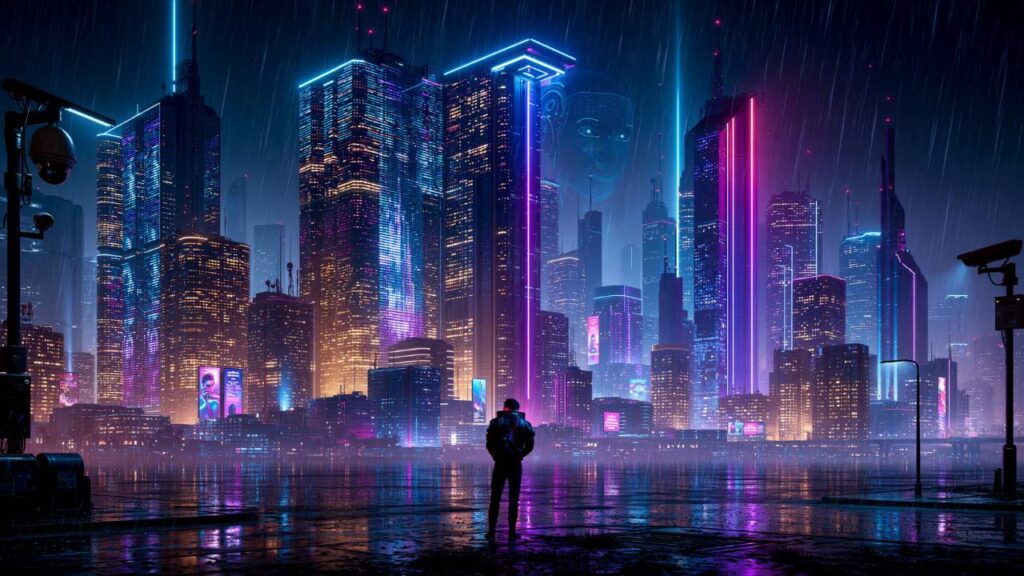
Follow Neon Ghost Frequencies as Wartonno builds a dark cinematic ambient world inspired by cyberpunk literature, AI, corporate power, damaged memories, and neon cities after midnight.
Summary
Cyberpunk remains relevant because its central themes increasingly resemble contemporary life. Artificial intelligence now participates in writing, images, music, coding, and communication. Companies can collect detailed behavioral and location data, algorithms influence visibility and choice, identity is partly performed through digital interfaces, and people may experience loneliness despite constant online connection. Cyberpunk explores these tensions through stories about corporate power, surveillance, inequality, digital identity, memory, and the relationship between humans and machines. Wartonno’s Neon Ghost Frequencies project translates those themes into dark cinematic ambient music.
Why cyberpunk still feels relevant
- AI is now part of ordinary creative and professional life.
- Companies can build detailed profiles from personal and behavioral data.
- Digital identity is increasingly shaped by platforms and algorithms.
- Constant connection does not automatically create emotional closeness.
- Technological progress and inequality can exist at the same time.
- Cyberpunk examines who controls technology, not only what technology can do.
- Its neon cities visualize the contrast between connection and isolation.
The first signal is After the System Broke—a dark cyberpunk ambient soundscape built around the burned-out hacker after the system finally goes quiet.
FAQ Section
Why is cyberpunk still relevant?
Cyberpunk remains relevant because its main themes—artificial intelligence, corporate power, surveillance, inequality, digital identity, information overload, and loneliness—are increasingly present in modern life.
Did cyberpunk predict the future?
Cyberpunk did not predict every technology literally. Its strength was anticipating how technology might interact with power, inequality, identity, corporate control, and human emotion.
Why is artificial intelligence important in cyberpunk?
AI allows cyberpunk to explore intelligence without a human body, systems operating beyond human understanding, corporate control of technology, and questions about consciousness, memory, identity, and creativity.
Why are corporations so powerful in cyberpunk stories?
Cyberpunk often imagines corporations controlling essential infrastructure, information, technology, security, or healthcare. This allows the genre to examine what happens when private systems gain power over everyday life.
What is digital loneliness?
Digital loneliness describes the experience of being continuously connected through devices or platforms while still lacking meaningful emotional closeness, belonging, or understanding.
Why do cyberpunk cities use neon and rain?
Neon communicates commerce, technology, advertising, nightlife, and artificial light. Rain creates reflection, distortion, melancholy, and emotional distance. Together, they turn the city into a visual expression of beauty, overstimulation, and loneliness.
Is Neon Ghost Frequencies connected to Neuromancer or Apple TV+?
No. Neon Ghost Frequencies is an independent Wartonno project inspired by the broader themes and atmosphere of cyberpunk literature. It is not an official soundtrack and is not affiliated with Apple TV+ or the Neuromancer production.