There are certain worlds you do not simply watch or read.
You return to them.
Blade Runner and Neuromancer are like that for me.
They are not only landmarks of cyberpunk. They are also two different ways of imagining what happens when technology moves closer to the human mind, the human body, and the human sense of self.
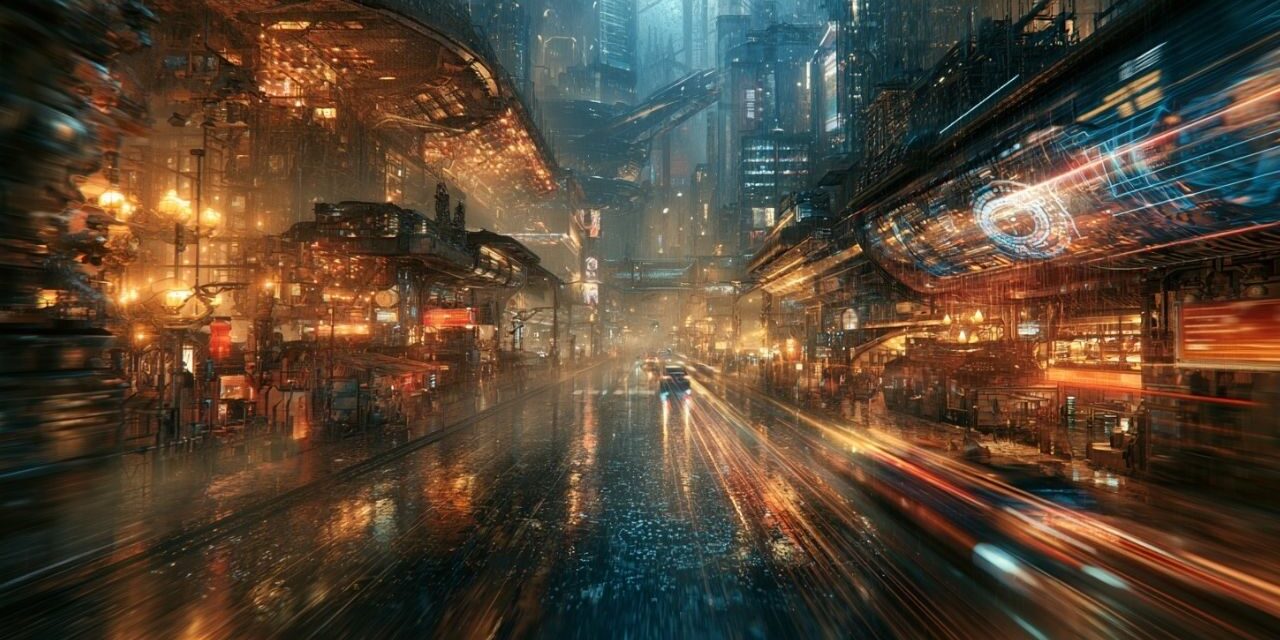
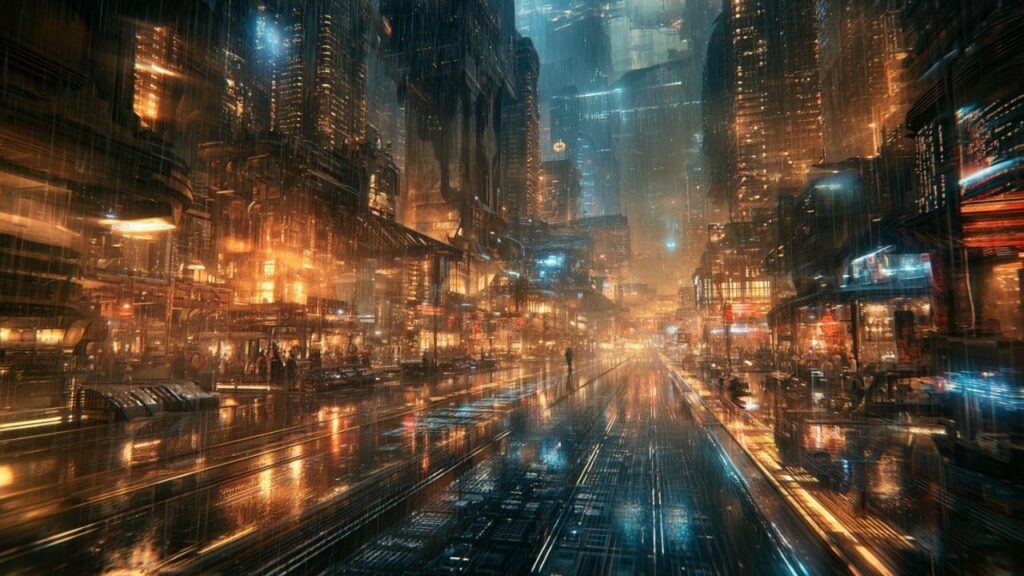
One gives me rain, distance, artificial light and the loneliness of the city.
The other gives me code, velocity, fractured identity and the feeling that memory itself may no longer belong entirely to us.
Somewhere between those two worlds, Neon Ghost Frequencies began.
This music project did not start because I wanted to imitate a famous science-fiction aesthetic. It started because I kept returning to the same kinds of questions.
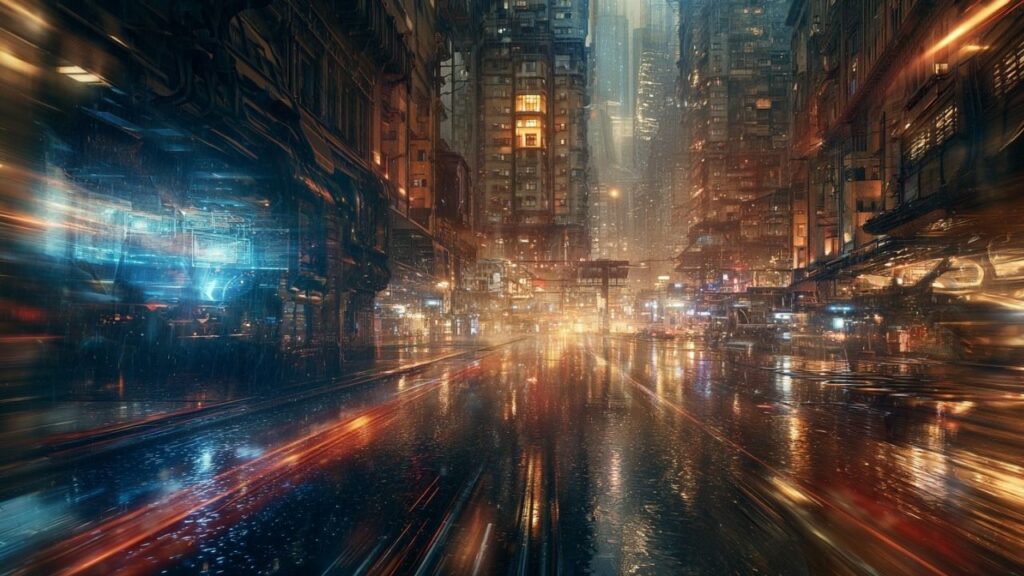
What does a city sound like after midnight when most of the people are gone, but the systems are still awake?
What does memory sound like once it becomes digital?
What remains inside a machine after its original purpose has faded?
And what kind of music belongs to a world where the line between the human and the artificial has become difficult to trust?
These questions led me toward the sound of Neon Ghost Frequencies.
Why I Keep Returning to Cyberpunk
I think the best cyberpunk is not really about gadgets.
It is about pressure.
Too much information.
Too much power.
Too much distance between the system and the individual.
It is about what happens when technology becomes intimate.
Not because it helps us.
Because it reaches us.
That tension has always interested me.
Cyberpunk is often remembered for its visual language. Neon. Rain. Towers. Screens. The city glowing against the dark.
But what stays with me most is the emotional atmosphere underneath it.
Isolation.
Exhaustion.
Desire.
Urban scale.
Human fragility inside systems that feel far too large to fully understand.
That emotional layer is what draws me back. And it is that layer, more than any surface style, that shaped the music I wanted to make.
What Blade Runner Gave Me
Blade Runner gave me atmosphere.
Not only the look of a future city, but the emotional weight of it.
A wet street reflecting light.
A distant siren.
Windows glowing high above the street.
A city filled with life, yet still carrying a profound kind of loneliness.
What I love most about Blade Runner is that it is rarely in a hurry. It allows the environment to speak.
It understands silence.
It understands distance.
It understands that a future can feel crowded and empty at the same time.
That taught me something important.
Music inspired by cyberpunk does not always need to be loud, aggressive or overloaded. It can be slow. Spacious. Almost patient.
It can let a single sound sit in the air long enough for you to feel the room around it.
It can suggest a city without describing every street.
It can hold melancholy without losing its sense of wonder.
From Blade Runner, I carried forward the rain, the urban loneliness, the reflective surfaces, the emotional quiet, and the sense that technology often leaves behind a very human sadness.
What Neuromancer Gave Me
If Blade Runner gave me atmosphere, Neuromancer gave me movement.
It gave me networks.
Data.
Espionage.
Artificial intelligence.
Speed.
It gave me a future where the digital world is not a background detail. It is a territory. A battleground. A place of temptation and danger.
What I have always found powerful in Neuromancer is the sense that consciousness, information and identity are no longer stable. Everything can be copied, hacked, stored, tracked, altered or fragmented.
That opens a very different emotional and musical space.
The city is still there, but now there is also the system behind the city.
The visible world and the invisible network.
The room and the data moving through the room.
The human presence and the digital afterimage of that presence.
Neuromancer helped shape my fascination with abandoned systems, damaged memory, lost signals and the possibility that machines may carry traces of us long after we think we are gone.
That is a large part of the emotional core of Neon Ghost Frequencies.
Where Neon Ghost Frequencies Begins
Neon Ghost Frequencies lives somewhere between those two poles.
Between the city and the network.
Between rain and signal.
Between physical loneliness and digital haunting.
It is not an attempt to recreate Blade Runner.
It is not an attempt to rewrite Neuromancer.
It is my own sound-world, shaped by some of the questions those works left behind in me.
In Neon Ghost Frequencies, I keep returning to:
- artificial memory
- abandoned networks
- damaged transmissions
- cities after midnight
- systems that continue running
- ghostly traces inside machines
- the emotional residue of technology
The project is cinematic, but it is also intimate.
I want the music to feel as if you have entered a place already holding a story.
Perhaps an apartment where the monitors are still glowing.
Perhaps an empty station where announcements still echo after service has ended.
Perhaps a system that no longer knows whether it is preserving memory or inventing it.
Each track is less like a song in the traditional sense and more like a fragment from a wider world.
Why This Became Ambient Music
I could have approached this world differently.
I could have made it louder. More beat-driven. More overtly futuristic.
But ambient music felt truer to the atmosphere I wanted.
Why?
Because ambient music leaves room.
Room for tension.
Room for thought.
Room for the listener to enter the world rather than simply observe it from outside.
Cyberpunk is often associated with intensity, but I am interested in the quieter hours of that world.
Not only the chase.
The aftermath.
Not only the bright billboard.
The empty corridor behind it.
Not only the crowded city.
The single lit window after 2 a.m.
Ambient music lets me work in that space.
It allows slow textures, distant signals, blurred edges, mechanical hum, suspended emotion, and silence that feels intentional.
That is important to me.
I want the music to feel less like a soundtrack trying to tell you what to feel and more like a place where your own thoughts can move around.
Tracks as Fragments
That is also how I think about the individual pieces inside Neon Ghost Frequencies.
Titles such as:
- After the System Broke
- Ghost in the Dead Network
- Memory Engine After Midnight
- The Signal That Remembered You
- Someone Was Still Listening
feel to me like fragments recovered from the same larger environment.
Each one suggests a moment.
A failure.
A trace.
A room.
A memory event.
A continuation of something that should perhaps have ended, but did not.
I like that approach because it keeps the project open.
Not every track needs to explain the whole world.
It only needs to reveal another corner of it.
Another signal.
Another afterimage.
Another emotional frequency.
The Future I Want to Hear
What I want from cyberpunk music is not only energy.
I want atmosphere with emotional depth.
I want technology to feel uncanny, not decorative.
I want the city to sound large enough to disappear into.
I want the machine to feel close enough to matter.
And I want the human presence to remain visible inside all of it, even if only as a trace.
That is what Blade Runner and Neuromancer gave me.
Not a template.
A direction.
A way of thinking about the future as something emotional, haunted, urban and unstable.
A way of understanding that the most interesting technological questions are often still human questions.
Who are we when memory changes form?
What do we leave behind inside the systems we build?
And how much of ourselves remains when the world becomes increasingly artificial?
Those questions continue to shape Neon Ghost Frequencies.
Why I Keep Making These Sounds
I think every project eventually reveals its deeper reason.
For me, Neon Ghost Frequencies is not only about cyberpunk.
It is about what happens when the modern world becomes strange enough to hear differently.
It is about the emotional weather inside technology.
It is about cities that still breathe after midnight.
It is about machines that remember.
And it is about the quiet feeling that somewhere inside the noise of the future, there is still a human signal trying to get through.
If Blade Runner and Neuromancer live somewhere in your imagination too, then perhaps you already understand the kind of space I am trying to make.
A space of rain.
Memory.
Light.
Signal.
Silence.
And the ghost in the system that never fully disappears.
Explore Neon Ghost Frequencies →
Listen to the Music →
Read more from the Journal →
About Wartonno →
FAQ
What is Neon Ghost Frequencies?
Neon Ghost Frequencies is Wartonno’s cinematic cyberpunk ambient music project. It explores themes such as artificial memory, abandoned networks, urban loneliness, digital ghosts and cities after midnight.
Is Neon Ghost Frequencies inspired by Blade Runner and Neuromancer?
Yes. Blade Runner and Neuromancer are important creative influences on the atmosphere, themes and emotional tone behind Neon Ghost Frequencies. The project is inspired by them, but it remains its own original music world.
What genre is Neon Ghost Frequencies?
Neon Ghost Frequencies sits between cyberpunk ambient, cinematic ambient and atmospheric electronic music. It focuses more on mood, texture and worldbuilding than on traditional song structure.
Why use ambient music for cyberpunk themes?
Ambient music creates space. It allows technology, memory, silence and atmosphere to feel more immersive. For Wartonno, that makes it a natural form for cyberpunk-inspired worldbuilding.
Which tracks belong to Neon Ghost Frequencies?
Tracks such as After the System Broke, Ghost in the Dead Network, Memory Engine After Midnight and The Signal That Remembered You belong to the project.