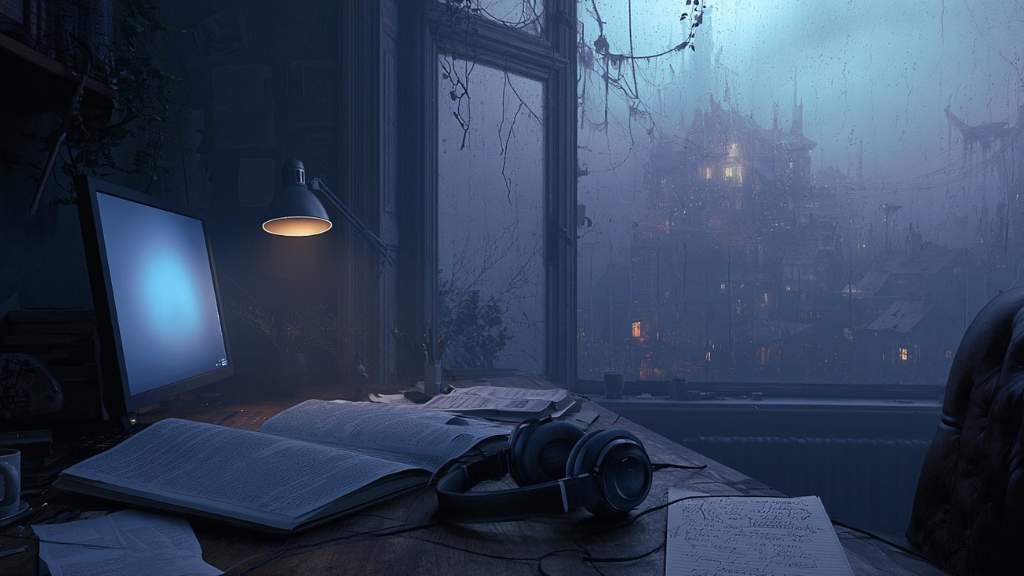
Music for the page before the words arrive
Writing often begins before the first sentence.
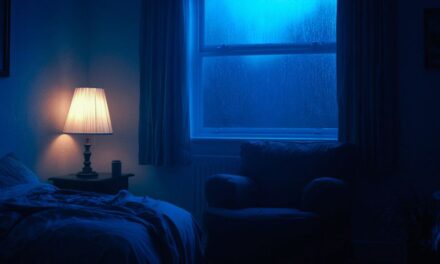
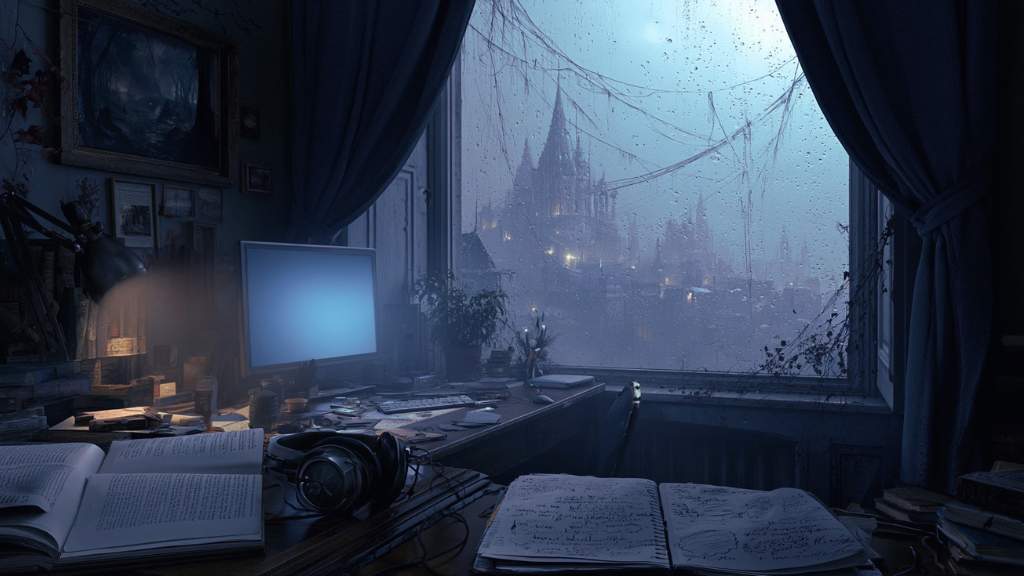
It begins in the room.
In the light.
In the silence.
In the mood that gathers around the desk before you touch the keyboard.
Sometimes the words arrive easily.
Other times, the page feels too bright. The mind feels too loud. The fictional world is there somewhere, but still behind glass.
That is where ambient music for writing can become useful.
Not as decoration.
Not as background noise for the sake of noise.
Not as something to fill silence because silence is uncomfortable.
But as atmosphere.
A soundscape can help the mind cross from ordinary life into creative attention. It can soften the room, slow the inner movement, and give the imagination a place to begin.
For me, this is one of the quiet functions of Wartonno Sound.
The music is not only for sleep, focus, or overthinking. It is also for writing. For fictional worlds. For the slow act of entering a place that does not fully exist yet.
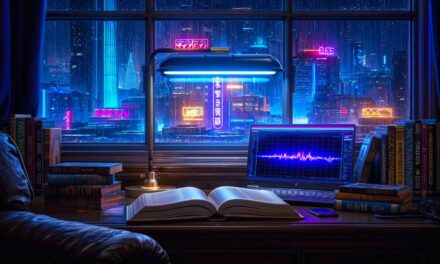
A track can become a room.
A room can become a street.
A street can become a city.
And sometimes, the city begins to speak.
Why writers use ambient music
Writers often need two things at the same time:
focus and atmosphere.
Focus keeps the hands moving.
Atmosphere keeps the imagination open.
Too much silence can make the mind over-aware of itself. Too much music can distract from the sentence. Lyrics can compete with language. Fast rhythms can pull the body into a different energy than the scene requires.
Ambient music works because it can sit between those extremes.
It gives the room a feeling without filling it with instructions.
Good ambient music for writing often has:
- little or no vocals
- slow movement
- soft textures
- long tones
- subtle repetition
- emotional depth
- enough atmosphere to shape the scene
- enough space to leave the words alone
It does not tell the writer what to write.
It gives the writer somewhere to write from.
That difference matters.
A song can become another voice in the room.
An ambient soundscape can become the room itself.
The difference between background music and writing atmosphere
Not all background music is good writing music.
Some music is made to entertain.
Some music is made to energize.
Some music is made to dominate attention.
Writing music has a different task.
It should support the work without becoming the work.
The best ambient music for writing acts almost like weather. You feel it, but you do not need to look at it every second. It changes the emotional temperature of the room. It makes the page feel less empty. It gives the fictional world a pressure, a color, a distance.
This is especially useful for fiction writing.
If you are writing a quiet scene, the sound can help you stay still.
If you are writing a mystery, the sound can hold tension.
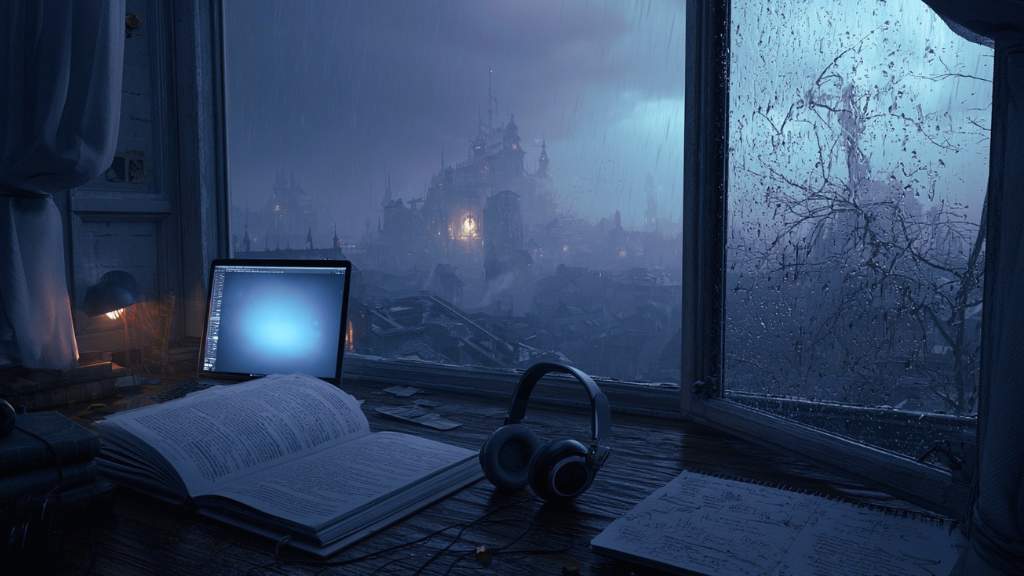
If you are writing a city, the sound can suggest architecture.
If you are writing horror, the sound can create unease without forcing it.
If you are writing a reflective essay, the sound can slow the mind enough for honesty.
Music becomes atmosphere when it stops asking for attention and starts shaping attention.
That is where writing begins to change.
Why dark ambient music works for fiction writing
Dark ambient music has a special relationship with fiction.
It does not need lyrics to suggest a story.
A low drone can feel like a locked building.
A distant pad can feel like fog over water.
A soft crackle can feel like an old tape recording.
A long reverb tail can feel like a hallway that does not end.
A barely moving texture can feel like something waiting behind a wall.
Dark ambient music works because it creates space for implication.
It does not explain everything.
It leaves room for the writer to listen into the silence.
This is useful for genres like:
- urban fantasy
- occult mystery
- psychological horror
- dystopian fiction
- supernatural suspense
- noir-inspired stories
- liminal fiction
- dreamlike literary fragments
- cinematic worldbuilding
A bright pop song may carry a clear emotional statement. A dark ambient soundscape may carry a question.
For writing, questions are often more useful.
They open doors.
Ambient music and the fictional world
A fictional world is not only built from plot.
It is built from mood.
Readers remember the feeling of a place. The smell of the street. The sound in the hallway. The kind of light in a room. The pressure behind a character’s silence.
Ambient music can help the writer discover those details.
When a soundscape plays, it can suggest:
- the pace of a city
- the emotional weather of a chapter
- the loneliness of a room
- the hidden tension in a conversation
- the scale of a landscape
- the distance between characters
- the unseen history beneath a scene
The music does not write the story for you.
It makes the atmosphere easier to hear.
For a writer, that can be enough.
Sometimes one texture can unlock an entire setting.
Sometimes one drone can reveal the emotional weight of a scene.
Sometimes one quiet sound can make a character feel closer.
This is why ambient music for writing is not just productivity music.
It is worldbuilding material.
How Wartonno Sound connects to writing
Wartonno Sound often begins with mood.
A restless evening.
A quiet room.
A threshold between thought and sleep.
A city in rain.
A feeling that does not want to become a sentence yet.
Those moods naturally connect to writing.
Many Wartonno Sound tracks are made as liminal soundscapes for focus, sleep, and escape, but they also work as creative spaces. They are slow enough to sit behind a writing session and atmospheric enough to suggest a world.
For writers, Wartonno Sound can support:
- drafting fiction
- editing chapters
- writing short stories
- building fictional cities
- outlining scenes
- journaling
- reading and note-taking
- writing at night
- working through atmospheric ideas
- creating a mood before entering a project
The goal is not to make writing easier in a mechanical way.
The goal is quieter.
To help the writer arrive.
To make the inner room stable enough for the fictional one to open.
Meridian City: when music becomes a world
Inside the Wartonno archive, the clearest connection between music and fiction is Meridian City.
Meridian City is a fictional universe of urban fantasy, occult mystery, strange evidence, rain-soaked streets, analog photography, hidden patterns, and characters who live close to the edge of reality.
It is a city that feels connected to dark ambient music because both work through atmosphere.
Meridian City does not begin only with plot.
It begins with weather.
Rain against neon.
A file left open in an empty office.
A darkroom light turning red.
A subway platform after midnight.
A hospital corridor that feels too long.
A symbol appearing where no one drew it.
A photograph that contains something the eye missed.
These are visual ideas, but they also have sound.
Low drones.
Distant static.
Soft footsteps.
Tape hiss.
A city breathing under concrete.
A tone that feels like memory.
This is where Wartonno Sound and Meridian City meet.
The music gives the fictional world an atmosphere before the story fully explains it.
Writing with Aya Lin and Mara Chen in mind
Two important figures in Meridian City are Aya Lin and Mara Chen.
They represent different ways of entering the same world.
Aya Lin belongs to investigation.
Her atmosphere is colder, sharper, more controlled. She moves through case files, occult patterns, ritual evidence, institutional silence, and the dangerous logic of hidden systems.
Music for Aya’s side of Meridian City might feel like:
- low drones
- restrained tension
- cold textures
- distant pulses
- quiet investigative pressure
- rain on concrete
- fluorescent light in an empty office
Mara Chen belongs to perception.
Her world is more fragile, more intimate, more haunted by images. She moves through photography, darkrooms, micro-sleep, memory, creative trauma, and the strange things that appear when a camera sees too much.
Music for Mara’s side might feel like:
- soft haze
- analog grain
- slow pads
- blurred melodies
- delicate distortion
- warm shadows
- a room between waking and dreaming
A writer can use music this way.
Not only as general background, but as a way to tune the emotional frequency of a character.
Before writing Aya, the room may need tension.
Before writing Mara, the room may need fracture.
Before writing Meridian City itself, the room may need rain.
How to use ambient music for writing sessions
You do not need a complicated system.
A small ritual is enough.
1. Choose the writing state
Before pressing play, ask what kind of writing you are entering.
Are you drafting?
Editing?
Worldbuilding?
Writing dialogue?
Writing atmosphere?
Planning a chapter?
Returning to a difficult scene?
The state decides the sound.
2. Choose one soundscape
Do not spend the whole session searching for the perfect playlist.
Choose one track, one album, or one longform video. Let it become the room.
3. Lower the friction
Close extra tabs. Put the phone away. Open only the document you need.
The music should mark the threshold.
Before this track: scattered.
After this track begins: writing.
4. Let the first minutes be arrival
Do not expect immediate flow.
Let the music gather around the room. Let the fictional world move closer.
5. Write one small entrance
Start with one sentence of place.
For example:
The rain had not stopped for three days.
The darkroom light made every face look guilty.
The file was already open when Aya arrived.
Mara knew the photograph was wrong before she developed it.
One sentence is enough.
The sound will help the next one appear.
Choosing the right ambient music for different writing tasks
Different writing tasks need different sound.
For drafting
Choose music with slow movement and emotional openness.
Drafting needs enough atmosphere to pull you forward, but not so much intensity that it freezes the page.
For editing
Choose something minimal and steady.
Editing needs clarity. Too much drama in the music can make it harder to see the sentence.
For worldbuilding
Choose immersive soundscapes.
Worldbuilding benefits from atmosphere. Dark ambient, liminal ambient, cinematic drones, and long textures can help a fictional place feel real.
For dialogue
Choose very subtle music.
Dialogue already has rhythm. The music should stay low and open, almost invisible.
For horror or mystery
Choose darker textures.
Low drones, distant tones, and restrained tension can help create unease without making the writing too theatrical.
For reflective writing
Choose warm, slow ambient music.
Journaling, essays, and personal reflection often need sound that feels spacious but not cold.
The right music does not force the writing.
It supports the state the writing needs.
Why lyrics can distract writers
Many writers avoid lyrical music while writing.
This is not because lyrical music is bad. It is because words compete with words.
When a song contains lyrics, the language part of the mind may begin listening. Even if the song is beautiful, it can pull attention away from the sentence you are trying to form.
Ambient music gives the language part of the mind more room.
There may be tones, textures, drones, soft melodies, and atmosphere — but fewer verbal signals to process.
This is why ambient music, dark ambient, classical minimalism, drone music, and instrumental soundscapes often work well for writing.
They support the page without adding another voice to it.
For overthinking writers, this can be especially useful.
The mind already has enough words.
Sometimes it needs sound without language.
Ambient music as a threshold into creative focus
Creative focus is not only concentration.
It is a state of entering.
You enter the project.
You enter the scene.
You enter the city.
You enter the emotional weather of the character.
Ambient music can become the threshold that helps this happen more consistently.
When you use the same kind of sound for writing, the mind begins to recognize the signal.
This is the room where we write.
This is the sound of returning.
This is the atmosphere of the project.
This is where the outside day becomes quieter.
Over time, the music becomes part of the ritual.
Not a rule.
A doorway.
That is one reason Wartonno Sound keeps returning to liminal soundscapes. Liminal music naturally belongs to thresholds. It helps move the listener from one state into another.
From noise into focus.
From daily life into fiction.
From scattered thought into one page.
From silence into atmosphere.
Choose your listening path: If you want to go directly into the sound, visit the Wartonno Sound listening gateway for playlists and tracks for overthinking at night, deep focus, overstimulation, liminal dreaming, and dark ambient escape.
Choose your listening path
If you want to go directly into the sound, visit the Wartonno Sound listening gateway for playlists and tracks for overthinking at night, deep focus, overstimulation, liminal dreaming, and dark ambient escape.
Use it when you do not want to search through everything.
Choose the state you are in.
Let the music meet you there.
Go to the Wartonno Sound listening gateway
A simple writing ritual with Wartonno Sound
Try this when you want to use ambient music for writing.
Step 1: Choose the doorway
Pick one:
- Focus
- Sleepy reflection
- Dark city atmosphere
- Liminal dreaming
- Emotional reset
- Meridian City mood
Step 2: Start the sound before the document
Let the music enter the room first.
Do not write immediately. Give the sound one or two minutes to change the atmosphere.
Step 3: Write the world before the plot
Begin with sensory detail.
What does the room sound like?
What kind of light is there?
What does the air feel like?
What is the character avoiding?
What is hidden in the place?
Step 4: Write for twenty minutes
No large goal.
Just stay inside the room for twenty minutes.
Step 5: Leave a trace
Before stopping, write one sentence for next time.
For example:
Next: Aya notices the symbol is older than the building.
Next: Mara checks the final negative and sees someone standing behind her.
Next: the music in the station changes key when the train arrives.
This gives the next session a doorway.
How ambient music helps build fictional memory
A strong fictional world feels like it existed before the story began.
Ambient music can help create that feeling.
Because ambient music often moves slowly, it gives the imagination time to sense what came before.
What happened in this building?
Why does this street feel abandoned?
Who lived in this room?
What does the city remember?
What sound has been playing beneath everything?
These questions are valuable for worldbuilding.
They make the fictional world feel layered.
Meridian City, for example, is not only a place where stories happen. It is a place with pressure beneath it. History. Ritual. Grief. Repetition. Signals. Rooms that remember too much.
Dark ambient music supports that kind of world because it often feels like something has already happened.
The track begins, and you arrive after the event.
That is a powerful place for fiction.
Writing, overthinking, and the need for a room
Many writers overthink.
Not only about life, but about the work itself.
Is this idea good enough?
Is the sentence right?
Is the world original?
Is the story too strange?
Should I begin somewhere else?
What if this project never becomes what I want it to be?
These thoughts can make the page feel heavier than it is.
Ambient music cannot remove that completely.
But it can create a room around the work.
A room where the first draft is allowed to be imperfect.
A room where the scene can arrive slowly.
A room where the writer does not need to solve the whole book tonight.
A room where one sentence is enough.
This is the same emotional territory that Wartonno Sound often explores.
Sound for when your mind won’t stop.
For writers, that sound can become a quiet permission:
You do not need the whole world yet.
Only the next line.
Where to go next
If you want to understand the wider Wartonno archive, start with:
- Start Here
- What Is Wartonno? The World Behind Wartonno Sound
- Wartonno Sound: Dark Ambient Music for Overthinking Minds
- What Is Meridian City? A Beginner’s Guide to the Fictional Archive
- Liminal Ambient Music for Focus, Sleep, and Escape
- Dark Ambient Music for Overthinking at Night
These pages connect the music, the fictional archive, the quiet tools, and the creative process behind Wartonno.
For listening, use the Wartonno Sound gateway when you want to move directly into a mood.
Focus.
Sleep.
Overthinking.
Liminal dreaming.
Dark ambient escape.
One doorway at a time.
Choose your listening path: If you want to go directly into the sound, visit the Wartonno Sound listening gateway for playlists and tracks for overthinking at night, deep focus, overstimulation, liminal dreaming, and dark ambient escape.
Frequently asked questions
Is ambient music good for writing?
Yes, ambient music can be useful for writing because it creates atmosphere without demanding too much attention. It can support focus, mood, worldbuilding, fiction writing, editing, and deep creative sessions.
What kind of music is best for writing fiction?
Instrumental music often works best for fiction writing, especially ambient music, dark ambient, liminal soundscapes, cinematic drones, and minimal focus music. Music without lyrics is less likely to compete with the language of the page.
Why does dark ambient music work for writing?
Dark ambient music works well for writing because it creates mood, depth, mystery, and emotional space. It can help writers enter fictional worlds, especially in genres like urban fantasy, occult mystery, horror, noir, and psychological suspense.
Can ambient music help with worldbuilding?
Yes. Ambient music can help with worldbuilding by suggesting atmosphere, place, emotional tone, architecture, weather, and hidden history. A soundscape can make a fictional city or room feel more real before it is fully described.
What is Wartonno Sound?
Wartonno Sound is a dark ambient and liminal ambient music project creating soundscapes for focus, sleep, writing, overthinking, emotional reset, and inner escape.
How is Wartonno Sound connected to Meridian City?
Wartonno Sound and Meridian City share the same atmosphere: rain, memory, hidden patterns, nocturnal spaces, emotional tension, and liminal mystery. The music often feels like the sound world behind the fictional city.
Is ambient music better than lyrical music for writing?
For many writers, yes. Lyrics can compete with the words being written, while ambient music creates mood without adding another voice. This makes it easier to stay with the sentence.
How should I use ambient music during a writing session?
Choose one track or playlist, start the music before opening the document, let the sound create the room, and begin with one sensory sentence. Use the music as a threshold into writing, not as another distraction.
Final reflection
Writing does not always begin with discipline.
Sometimes it begins with atmosphere.
A room becoming quiet.
A sound entering the background.
A sentence arriving from somewhere below thought.
A fictional city opening one street at a time.
Ambient music for writing is not there to do the work for you.
It is there to make the work easier to enter.
A drone becomes weather.
A texture becomes distance.
A tone becomes a room.
A room becomes a world.
And somewhere inside that world, a character waits for you to listen.