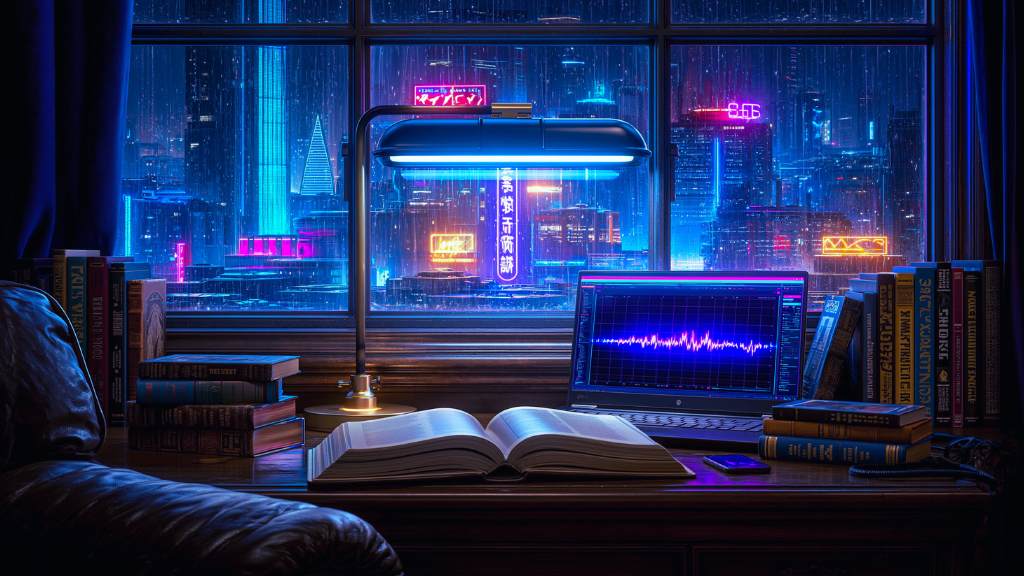
Dark Ambient Music for Reading Cyberpunk: Soundscapes for Neuromancer, Neon Noir, and AI Fiction
Summary:
Dark ambient music for reading cyberpunk is atmospheric background music designed to support cyberpunk novels, AI fiction, neon noir stories, writing, coding, and worldbuilding without distracting from the text. It often uses slow pads, low drones, rain textures, machine hum, soft industrial ambience, broken melodic fragments, and subtle pulses instead of strong beats or vocals. Wartonno’s Neon Ghost Frequencies project explores this sound world through dark cinematic ambient tracks inspired by cyberpunk story tropes, beginning with After the System Broke, a soundscape based on the burned-out hacker trope.
Reading cyberpunk asks for a certain kind of silence.
Not empty silence.
Something darker.
Something electric.
Something with rain behind it.
A good cyberpunk novel does not only tell you about a future city. It puts you inside one. The room changes. The light becomes colder. The screen beside you feels a little more alive. The sound of traffic outside begins to resemble data moving through a system you cannot see.
That is why the right music matters.
Cyberpunk does not always need fast beats, aggressive synths, or action-driven energy. Sometimes the best soundtrack for cyberpunk reading is slow, dark, cinematic ambient music: low drones, rain textures, machine hum, unstable pads, soft pulses, and enough space for the words on the page to breathe.
This is where dark ambient music for reading cyberpunk becomes useful.
It does not replace the book.
It builds the room around it.
Why cyberpunk reading needs a different kind of background music
Not all background music works for reading.
Music with strong lyrics can interrupt the inner voice of the text. Fast beats can pull attention away from the page. Big melodic hooks can turn the music into the main event.
Cyberpunk needs something more subtle.
The music should create atmosphere without taking control.
It should feel like:
rain on glass
a city glowing beyond the window
a server room beneath the floor
a machine still running after midnight
a human mind surrounded by systems
a future that feels too close
That is why dark ambient works so well.
Dark ambient music can support reading because it often uses texture, space, tone, and slow movement instead of traditional song structure. It gives the imagination a landscape without forcing a narrative on top of the book.
For cyberpunk, that landscape matters.
The genre is full of cities, hackers, artificial intelligence, corporate power, damaged memory, body modification, surveillance, and digital loneliness. The right soundscape can make those themes feel physically present while you read.
The first Wartonno soundscape in this world is called After the System Broke — dark cinematic ambient music built around the cyberpunk trope of the burned-out hacker.
Reading Neuromancer with dark ambient music
William Gibson’s Neuromancer is one of the defining works of cyberpunk literature. Apple TV+ has announced a 10-episode drama series based on Gibson’s novel, created for television by Graham Roland and JD Dillard.
That renewed attention makes this a good moment to return to cyberpunk reading itself — not only as nostalgia, but as atmosphere.
A book like Neuromancer does not need music that explains it. It needs music that leaves enough space for the prose, the characters, and the strange pressure of the world to unfold.
For reading Neuromancer or similar cyberpunk fiction, the ideal music is not too heroic. It should not feel like a blockbuster trailer. It should not overpower the page.
It should feel like the edge of a signal.
Dark ambient music can support that experience through:
slow pads
low-frequency drones
cold room tone
distant industrial noise
rain and city ambience
minimal melodic fragments
subtle pulses that feel like data transfer
The goal is not to create an official soundtrack.
The goal is to create a private reading environment — a small sonic city around the book.
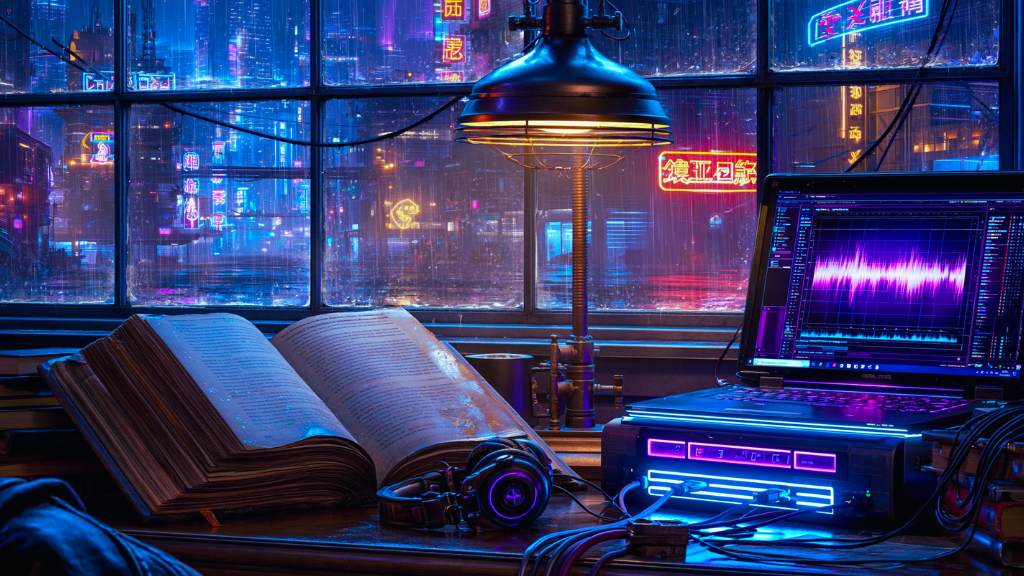
Cyberpunk ambient vs synthwave for reading
Many people search for cyberpunk music and find synthwave first.
That makes sense. Synthwave has neon, retro-futuristic visuals, analog synths, night roads, and a strong cinematic identity. But for reading, synthwave is not always the best fit.
Synthwave often moves forward.
Dark cyberpunk ambient stays with you.
Synthwave often has rhythm and nostalgic energy.
Cyberpunk ambient is slower, more spacious, and more psychological.
Synthwave can feel like driving through the city.
Dark ambient can feel like sitting inside the city after the drive is over.
For reading, that difference is important.
A steady beat can be useful for focus, but it can also become distracting. A big lead melody can be beautiful, but it may compete with the author’s language. A more ambient approach lets the book remain central.
The music becomes architecture.
It becomes the room.
What should cyberpunk reading music sound like?
Cyberpunk reading music should be immersive but not intrusive.
It should give the listener a dark cinematic atmosphere while leaving enough mental space for reading, writing, coding, or worldbuilding.
A strong cyberpunk reading soundscape often includes the following elements.
1. Slow, unstable pads
Pads are the emotional foundation.
For Wartonno’s Neon Ghost Frequencies project, the main sonic identity is built around Brackish Pads from The Crow Hill Company. The appeal of this kind of sound is instability: slightly damaged warmth, strange movement, and textures that feel less polished than traditional cinematic pads.
That imperfection fits cyberpunk.
A clean pad can feel beautiful.
A brackish pad can feel alive, tired, corrupted, and human in a machine-like way.
2. Low drones
Low drones create scale.
They can suggest a megacity, corporate infrastructure, underground transport, server rooms, or hidden machinery behind the walls.
For reading, the drone should be felt more than noticed.
It should not dominate.
It should sit underneath the scene like pressure.
3. Rain and window ambience
Rain is one of the most useful emotional textures in cyberpunk.
It gives the city a body.
It softens the machine world.
It makes neon feel human.
Rain also creates continuity. It can run quietly across an entire track without demanding attention, making it ideal for long reading sessions.
4. Machine hum and soft industrial texture
Cyberpunk is not only visual. It is infrastructural.
Fans, power grids, server noise, distant engines, cables, vents, transformers, and room tone can all help create the feeling of a world that is always running.
These sounds should remain soft and atmospheric.
Not harsh noise.
Not industrial assault.
More like tired machinery breathing in the next room.
5. Broken melodic fragments
A full melody can sometimes distract from reading.
But small fragments work beautifully.
Three notes.
A distant bell.
A half-remembered piano tone.
A synth line that appears once and disappears.
These fragments can feel like memory, especially in cyberpunk, where identity and memory are often unstable.
6. A slow pulse instead of drums
For reading cyberpunk, rhythm should be handled carefully.
A pulse can be useful if it feels like a system heartbeat rather than a beat.
Think:
data transfer
distant train
heart monitor
electrical click
failing signal
low machine throb
This gives the track movement without turning it into action music.
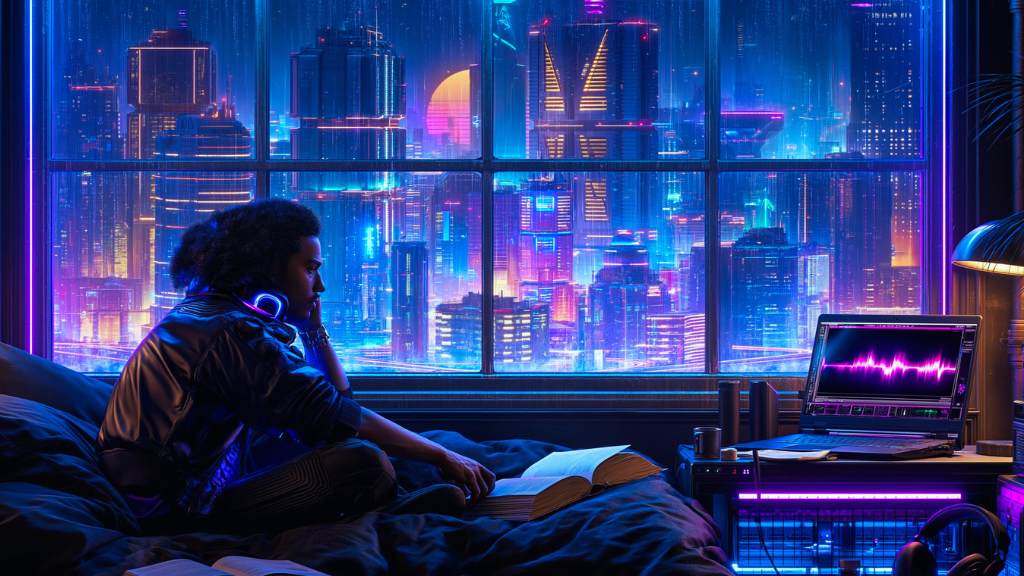
Dark ambient music for AI fiction
Cyberpunk and AI fiction naturally belong together.
Artificial intelligence creates a very specific emotional atmosphere: intelligence without a body, memory without humanity, presence without breath.
That is why AI can feel ghostly in sound.
In dark ambient music, AI can be suggested through:
glassy pads
distant digital textures
reversed fragments
subtle pitch instability
granular movement
ghost-like voice textures without words
cold harmonic spaces
signals that almost become language
For reading AI fiction, this kind of music can help the listener feel the presence of something non-human without needing obvious robotic sounds.
The most interesting AI atmosphere is not “robotic.”
It is uncertain.
It asks:
Is something listening?
Is this a machine?
Is this memory?
Is this a voice?
Is this still human?
That uncertainty is one of the strongest emotional spaces in cyberpunk ambient music.
Dark ambient music for coding
Cyberpunk ambient also works well for coding because it shares a natural relationship with screens, systems, logic, repetition, and late-night focus.
But coding music needs balance.
Too much drama becomes distracting.
Too little movement becomes sleepy.
Too much rhythm becomes tiring over time.
A good cyberpunk coding soundscape should be steady, atmospheric, and low-distraction.
It can include:
soft pulses
slow drones
subtle digital noise
minimal harmonic changes
rain ambience
dark pads
no lyrics
no sudden jumps in volume
The ideal state is not excitement.
It is immersion.
You want the music to make the screen feel like a place, without pulling your attention away from the work.
That is why dark cinematic ambient can be useful for coding, especially at night.
It creates a quiet system around the system you are building.
Dark ambient music for writing cyberpunk and sci-fi
Writing cyberpunk requires a slightly different use of music.
When writing, music is not only background. It becomes a worldbuilding tool.
The right sound can help you imagine:
the temperature of a room
the size of a city
the loneliness of a character
the pressure of a corporation
the presence of an artificial intelligence
the silence after a system failure
the emotional residue of a memory that does not fully belong to someone
For writing, cyberpunk ambient should open doors without writing the scene for you.
It should suggest.
Not explain.
That is also why slower, less melodic music often works best. It creates enough atmosphere to keep you inside the world, but not so much narrative that it competes with your own.
A good writing soundscape feels like a threshold.
You step through it, and the fictional world begins to hold together.
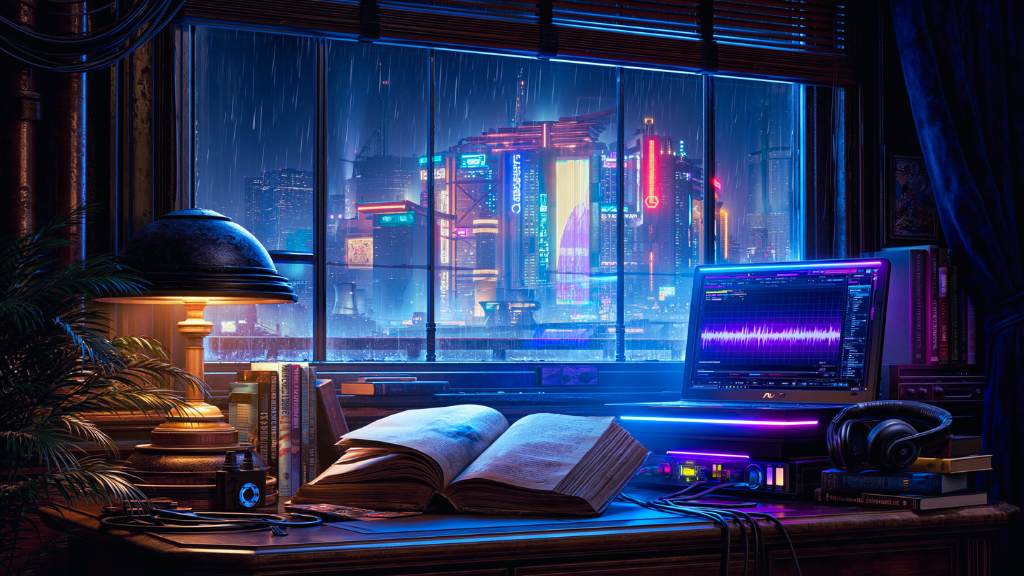
The first Wartonno soundscape: After the System Broke
The first track in Wartonno’s new project Neon Ghost Frequencies is being shaped around the cyberpunk trope of the burned-out hacker.
The working title is:
This is not the sound of the hack itself.
It is the sound after the hack.
After the alert.
After the crash.
After the body finally realizes how tired it is.
The image is simple:
a dark apartment after midnight
rain on the window
old monitors still glowing
black cables across the desk
a city outside that refuses to sleep
a mind too full of signal to rest
This track is being built as dark cinematic ambient music for reading, coding, writing, worldbuilding, and night focus.
The sound direction:
Brackish Pads
low drone
soft machine hum
rain texture
broken melodic fragments
slow pulse
no hard beat
no vocals
no dramatic trailer structure
The emotional goal is aftermath.
The listener should feel as if the system has broken, but the signal is still alive somewhere.
How to listen to dark ambient while reading cyberpunk
The best way to use dark ambient music for reading is simple.
Keep the volume low.
The music should sit behind the book, not in front of it. If you notice the track too much, it may be too loud or too busy.
A useful reading setup:
dim light
phone away
book, e-reader, or tablet ready
dark ambient playlistat low volume
no lyrics
long tracks or seamless loops
rain, pads, and slow drones preferred
For cyberpunk, a slightly darker room helps. Not because it is dramatic, but because it lets the sound and text occupy the same space.
You are not trying to create a performance.
You are creating a small ritual.
The city outside can be real or imagined.
The signal begins when you start reading.
Recommended listening situations
Dark ambient cyberpunk music works especially well for:
reading Neuromancer
reading classic cyberpunk novels
reading AI fiction
writing sci-fi scenes
coding at night
designing fictional cities
worldbuilding for stories or games
tabletop roleplaying preparation
late-night focus
rainy work sessions
visual moodboarding
overthinking evenings
The same soundscape can serve different uses because cyberpunk is already a hybrid space: part fiction, part technology, part psychology, part city, part dream.
Why Neon Ghost Frequencies exists
Neon Ghost Frequencies is a dark cinematic ambient project by Wartonno.
It is built around cyberpunk story tropes, machine-haunted atmospheres, neon noir imagery, artificial intelligence, damaged memory, hackers, corporate systems, and future cities that feel strangely close.
The project is not official soundtrack music.
It is not connected to Apple TV+.
It is not music “from” Neuromancer.
It is an original Wartonno project for the emotional spaces around cyberpunk stories — the reading room, the writing desk, the coding session, the rainlit window, the overthinking mind, and the quiet moment after the machine stops making sense.
The Wartonno writing and sound world is calm, poetic, liminal, emotionally intelligent, and quietly practical — a style that gives the listener atmosphere without hard-selling or overexplaining.
Cyberpunk ambient gives that world a new architecture:
not abandoned hallways, but server rooms
not old ghosts, but artificial ones
not empty houses, but neon apartments
not silence, but signal
Final thought
Dark ambient music for reading cyberpunk should not tell you what to feel.
It should create the conditions for the book to become more vivid.
A low drone.
Rain on glass.
A soft machine hum.
A pad that feels slightly damaged.
A pulse that might be a heartbeat, or data, or the last trace of a broken system.
That is enough.
The page remains the center.
The music becomes the city around it.
And somewhere in that city, the first signal from Neon Ghost Frequencies begins to appear.
After the System Broke is coming.
Neon Ghost Frequencies is beginning soon. Follow Wartonno for dark cinematic ambient music inspired by cyberpunk literature, neon noir, artificial intelligence, damaged memory, hackers, and machine-haunted cities.
FAQ
What is the best music for reading cyberpunk?
The best music for reading cyberpunk is usually instrumental, atmospheric, and low-distraction. Dark ambient, cyberpunk ambient, cinematic drones, rain soundscapes, and neon noir textures work well because they support the mood without interrupting the text.
Is dark ambient good for reading Neuromancer?
Yes, dark ambient can work very well for reading Neuromancer because it creates a slow, futuristic, neon-noir atmosphere without overpowering the prose. Low drones, rain, machine hum, and subtle pads can help support the book’s cyberpunk setting.
What makes cyberpunk reading music different from synthwave?
Synthwave is often more rhythmic, nostalgic, and energetic. Cyberpunk reading music is usually slower, darker, more atmospheric, and less distracting. It is designed to create space for reading, coding, writing, or worldbuilding.
Can I use cyberpunk ambient music for coding?
Yes. Cyberpunk ambient music can be useful for coding because it often has no lyrics, minimal melodic distraction, steady textures, and a focused technological atmosphere. It works especially well for late-night coding sessions.
What should cyberpunk ambient music sound like?
Cyberpunk ambient music often uses unstable pads, low drones, rain textures, machine hum, subtle digital noise, soft industrial ambience, broken melodies, and slow pulses that feel like data, machinery, or distant city infrastructure.
Is Neon Ghost Frequencies an official Neuromancer soundtrack?
No. Neon Ghost Frequencies is an original dark cinematic ambient project by Wartonno. It is inspired by cyberpunk literature, neon noir, AI fiction, damaged memory, and machine-haunted cities, but it is not official soundtrack music and is not connected to Apple TV+.