
AI anxiety and liminal ambient music. Finding Psychological Shelter in the Age of Artificial Intelligence
The Quiet Fear Beneath the Algorithm
We are not only living through a technological shift.
We are living through a psychological one.
Artificial intelligence no longer feels abstract. It writes. It paints. It composes. It reasons. It predicts. It replaces.
And beneath the productivity headlines, something more fragile moves:
a subtle, unspoken question—
If machines can create, where does that leave us?
This is the emotional core of what researchers and psychologists increasingly describe as AI anxiety—a form of anticipatory stress driven not by immediate danger, but by existential uncertainty.
Not fear of robots.
Fear of irrelevance.
Not fear of tools.
Fear of displacement.
And because this fear is intangible, it lingers.
AI Anxiety: A Cultural Nervous System Response
AI anxiety is not irrational. It is neurobiological.
When uncertainty rises, the nervous system activates:
- Elevated cortisol
- Hypervigilance
- Doom-scrolling behaviors
- Compulsive comparison
- Future catastrophizing
Unlike traditional threats, AI is not visible.
It is ambient.
It lives in feeds.
In headlines.
In job market projections.
In generative outputs that blur the line between human and machine.
The result is a low-grade, chronic stress state.
We are overstimulated by possibility.
And overstimulation is not innovation.
It is fatigue.
The Liminal Condition of 2026
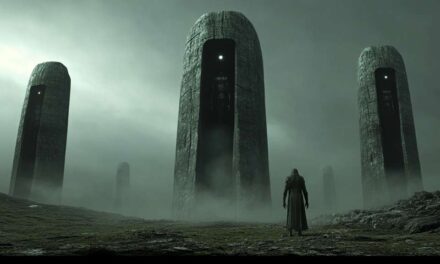
We are in a threshold.
Not post-human.
Not pre-human.
A liminal space between authorship and automation.
Anthropologists define liminality as the in-between stage during transitions, when old structures dissolve but new ones are not yet stable.
That is exactly where we stand.
The human creative identity, once considered sacred, now feels negotiable.
And liminal spaces produce two things:
- Disorientation
- Transformation
The difference depends on whether we can regulate our internal response.
How Liminal Ambient Music Regulates the Nervous System
Liminal ambient music operates differently from commercial, high-energy sound.
It does not command attention.
It creates space.
From a neuropsychological perspective, ambient soundscapes can:
- Lower sympathetic nervous system activation
- Support parasympathetic recovery
- Reduce cognitive load
- Slow breathing rhythms
- Stabilize heart rate variability
Particularly when built around:
- Slow attack envelopes
- Long reverb tails
- Minimal rhythmic pressure
- Sparse harmonic movement
- Wide spatial textures
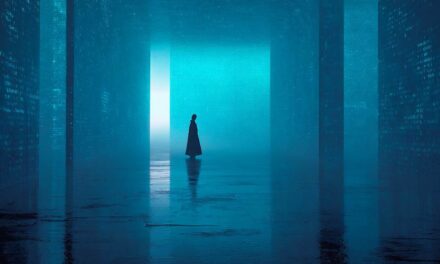
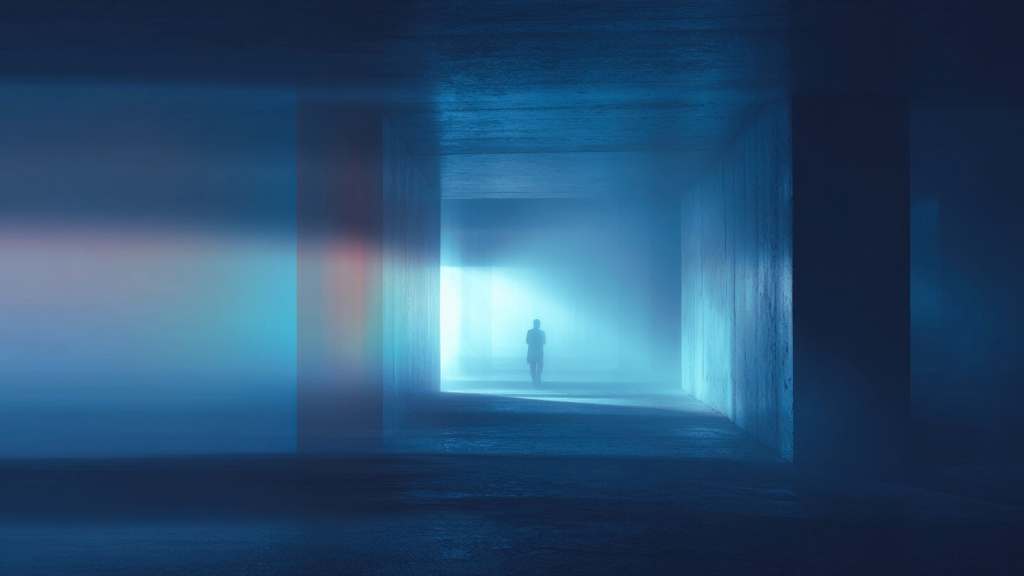
Liminal ambient music mimics the acoustic qualities of safe, open spaces.
Cathedrals.
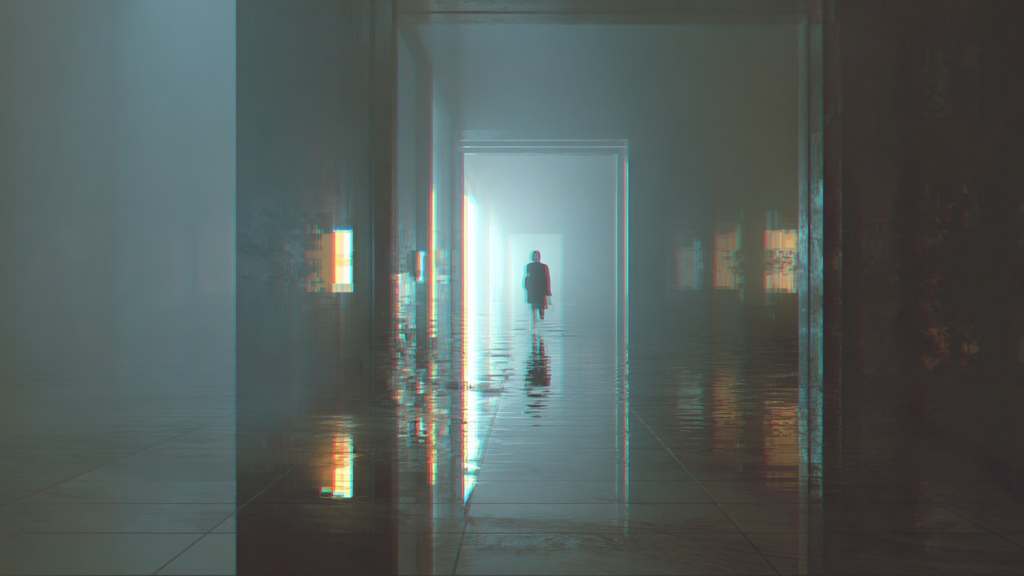
Empty halls.
Distant fields.
Quiet corridors.
In moments of AI-driven overstimulation, these sonic architectures become psychological shelter.
The Role of Uncertainty in Creative Identity
The fear that AI will “replace” human creativity reveals something deeper:
We have tied our identity to output.
But liminal ambient music does something radical.
It decouples identity from productivity.
It reminds us that:
Presence precedes production.
Being precedes creating.
Machines may replicate style.
They cannot replicate lived memory.
They cannot replicate grief, or longing, or the texture of a childhood room at dusk.
They cannot feel nostalgia for futures that never arrived.
Liminal ambient music holds those textures without competing.
Meridian City as Cultural Mirror
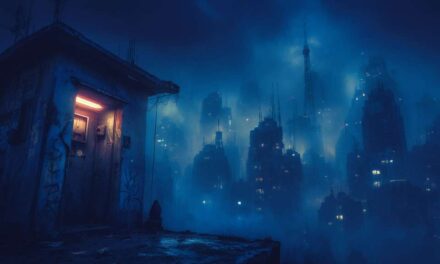
In the Meridian City universe, thresholds are everywhere.
Inspector Aya Lin investigates crimes that exist between realities.
Mara Chen captures photographs that reveal invisible layers beneath the city.
These are not fantasy metaphors.
They are psychological ones.
Meridian City represents what it feels like to live in a world where:
- Reality glitches
- Identity fractures
- Systems evolve faster than the human heart
AI anxiety mirrors this atmosphere.
You are not broken for feeling unsettled.
You are standing in a threshold.
Why Silence Feels Threatening Now
There was a time when silence meant rest.
Now silence feels like falling behind.
When feeds pause, the mind fills with comparison.
AI amplifies this by producing infinite content without fatigue.
Humans interpret infinite production as pressure.
Liminal ambient music reintroduces permission.
Permission to:
- Not optimize
- Not compete
- Not respond immediately
- Not generate
In a world obsessed with acceleration, stillness becomes rebellion.
The Cultural Shift Ahead
AI will continue to expand.
That is inevitable.
The question is not whether machines will create.
The question is whether humans will remember how to inhabit their interior world.
Liminal ambient music does not resist technology.
It stabilizes the human nervous system inside it.
It creates a buffer between input and reaction.
And that buffer is where identity survives.
Curated Listening: A Psychological Reset
If you are feeling overwhelmed by AI discourse, begin with listening — not consuming.
Start with a low-light environment.
Minimal screens.
Headphones if possible.
Suggested direction:
Wartonno Sound – Liminal Focus / Unfound Series
(Available on Spotify and YouTube)
Tracks such as:
- Glimorrow
- Driftveil
- Farsleeper
- Unbloom
These compositions are built around slow-moving tonal beds, distant harmonic suspensions, and open spatial architecture designed to reduce cognitive friction.
Let the sound exist without demanding outcome.
AI Anxiety Is Not About Technology
It is about meaning.
When the external world accelerates, the internal world must deepen.
Liminal ambient music does not promise answers.
It creates room.
And room is what anxiety cannot survive in.
Because anxiety feeds on compression.
Space dissolves it.
Final Reflection
We are not witnessing the end of human creativity.
We are witnessing its evolution through uncertainty.
Every era has a threshold.
This one hums in digital static.
And in that hum, you still breathe.
Not optimized.
Not replaced.
Still here.
Call to Action
If this resonated:
▢ Explore the curated liminal ambient collection on Spotify
▢ Listen to the Unfound series on YouTube
▢ Visit the full discography and Meridian connections
Let sound become the threshold you control.